Why deals stall in the pipeline, and how to close them faster
Most stalled deals are not lost to a competitor. They end in no decision, because nobody owns the next step, one contact carries the whole decision, or the buyer is afraid of choosing wrong. How to spot them, restart them and close faster.
 By
10 min read
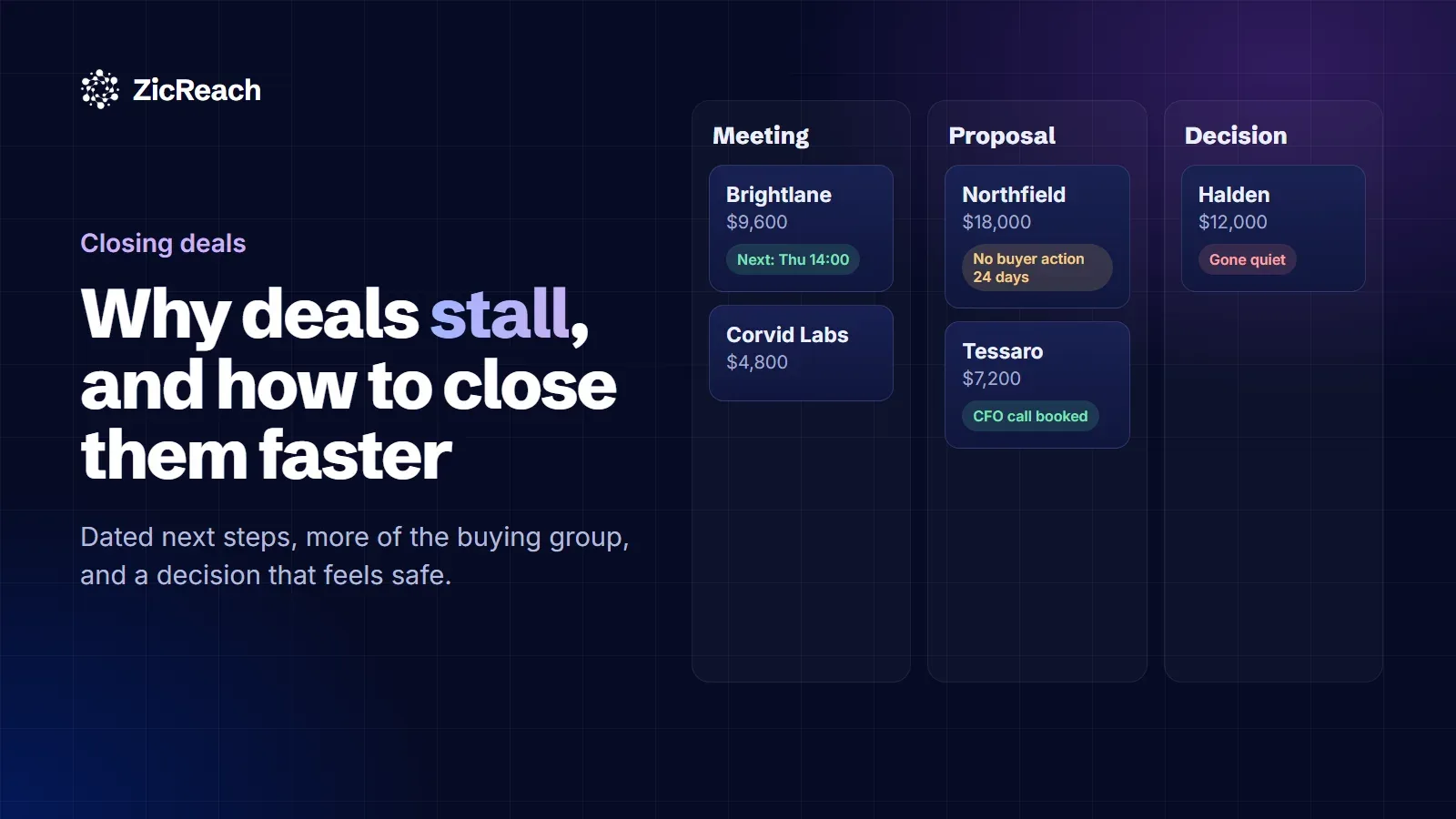
Most B2B deals stall because the buyer cannot decide, not because they chose a competitor. The usual causes are no agreed next step, a single contact who cannot sign, value that was never put in numbers, and fear of making the wrong choice. You close faster by agreeing dated next steps on every call, reaching the whole buying group early, and making the decision feel safe and small.
A stalled deal is easy to miss. It still sits in your pipeline at the same value, the contact still sounds positive when you reach them, and the forecast still says "this month". Meanwhile the buyer has moved on to other things. This guide covers how to spot a stalled deal, why it happens, and how to get it moving or let it go.
What counts as a stalled deal?
A deal is stalled when it has stopped moving forward and the buyer has not said no. A simple working rule: if a deal has had no buyer action for twice as long as deals usually spend in that stage, treat it as stalled. "Buyer action" means something the buyer did, such as replying with substance, booking a call, sharing a document or introducing a colleague. Your own follow ups do not count.
That rule matters because sellers tend to measure activity: "I emailed them twice this week". Activity on your side says nothing about whether the deal is alive.
Key numbers
| Number | What it tells you | Source |
|---|---|---|
| 2.5 million | Recorded sales conversations analysed for research into why deals end in no decision. | The JOLT Effect, Dixon and McKenna |
| 40% to 60% | Share of deals in that research that ended in no decision rather than a loss to a competitor. | The JOLT Effect, Dixon and McKenna |
| 6 to 10 | Typical number of people in the buying group for a complex B2B purchase. | Gartner |
| 67% | Share of B2B buyers who prefer a buying experience without a sales rep. | Gartner, March 2026 |
| 28% | Share of a sales rep's week spent actually selling. | Salesforce State of Sales |
Why do deals stall? Eight common reasons
1. The buyer is afraid of choosing wrong
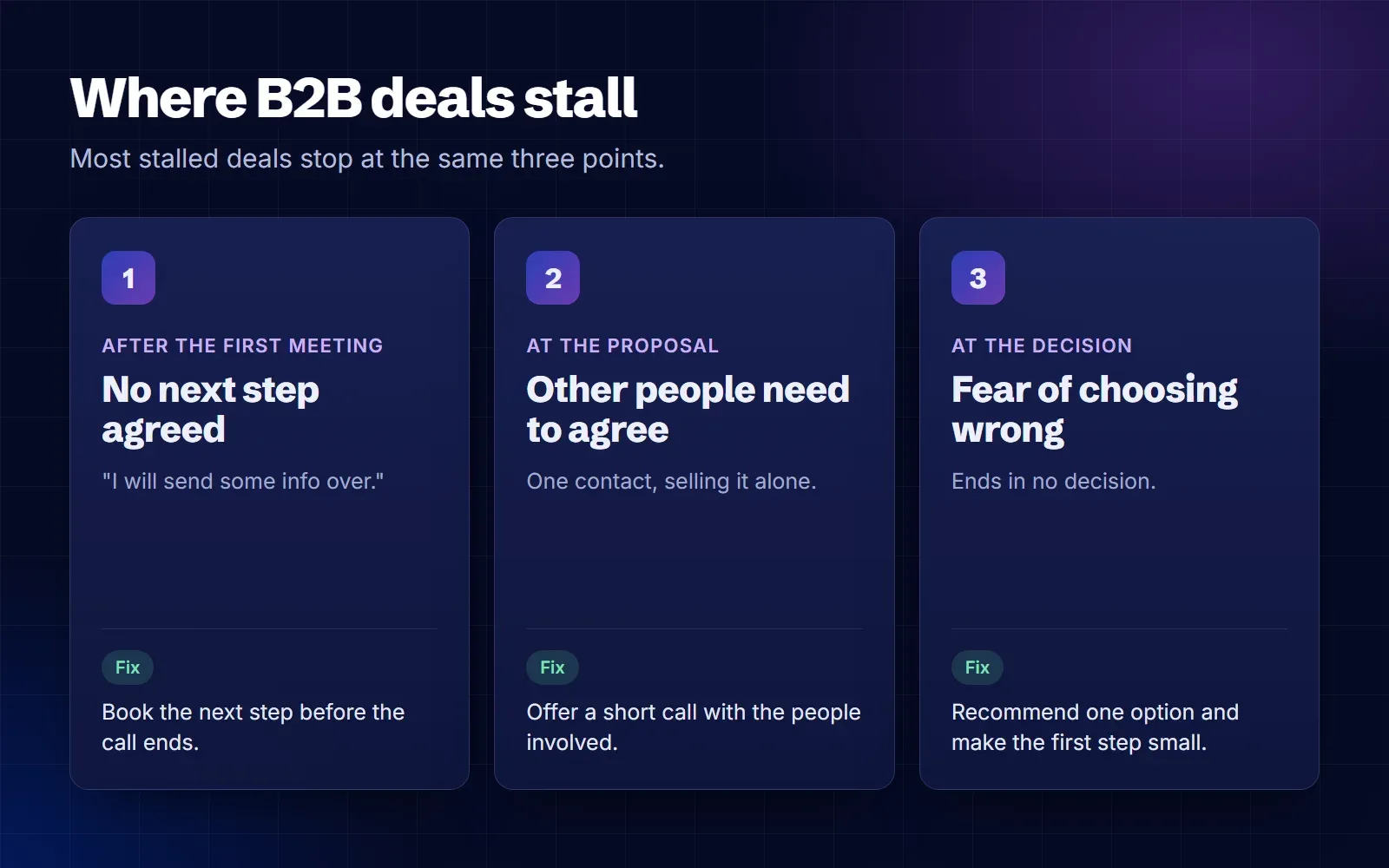
In their book The JOLT Effect, Matthew Dixon and Ted McKenna describe research on 2.5 million sales conversations, which found that between 40% and 60% of deals end in no decision. Their key finding was that most of those losses came from indecision, the buyer's fear of making a mistake, rather than a real preference for things as they are. Many sellers respond by adding more features and more options, which makes the fear worse.
2. There is no agreed next step
A call that ends with "I will send some info over and we will be in touch" has no next step. Neither side owns the next move, so nobody makes it. Deals keep moving when every conversation ends with a date, a time and a named action.
3. You are talking to one person
Gartner's research on B2B buying puts the typical buying group for a complex purchase at six to ten people. If you only know one of them, your deal depends on how well that person can sell your product internally, with your slides, while doing their actual job. When they get stuck, they go quiet.
4. The value was never put in numbers
"This will save your team time" is easy to agree with and easy to ignore. "This saves your three SDRs about six hours a week each, which is roughly one extra day of calls" gives the buyer something to repeat to their manager and a reason to act this quarter.
5. The pain is not urgent
Some deals were never real. The buyer liked the idea but has no deadline and no cost to waiting. Better qualification catches these early; our guide on how to qualify leads before a sales call covers the questions that expose them.
6. The buying process surprised you
Security questionnaires, legal review, procurement, a budget cycle that resets in January. None of these are objections, but each adds weeks if you find out about them at the end. Ask how they bought the last tool like yours, early.
7. Buyers want to do more without you
A Gartner sales survey published in March 2026 found that 67% of B2B buyers prefer a rep free buying experience. If your deal only moves when you are on a call, it stops whenever the calendar fills up. Material the buyer can use alone, such as a short recorded demo, clear pricing and a one page business case, keeps it moving between meetings.
8. The deal was neglected on your side
With reps spending only 28% of their time selling, according to Salesforce's State of Sales research, deals do stall on the seller's side too. A proposal that goes out four days after the call, or a follow up that waits until the next pipeline review, tells the buyer this is not a priority for you either.
Is the deal stalled or just slow?
Not every quiet deal is in trouble. Some buyers move slowly and steadily. This table helps tell the difference.
| Signal | Slow but healthy | Stalled |
|---|---|---|
| Next step | Agreed, with a date | None, or "we will get back to you" |
| Contacts | Two or more people engaged | One contact, getting harder to reach |
| Buyer actions | They share documents, ask questions, invite others | Only you send messages |
| Timeline | Tied to a real event, such as a launch or a hire | "Sometime this quarter" |
| Objections | Specific, such as security or pricing terms | Vague, such as "we need to think about it" |
How do you unstick a stalled deal? Step by step
- Diagnose before you chase. Reread your notes. Where did momentum stop, and which of the eight reasons fits? A follow up that addresses the real cause beats three that ask for an update.
- Make a recommendation. Dixon and McKenna's JOLT method starts by judging how much indecision is at play and then offering a clear recommendation instead of more options: "Based on what you told me, I would start with your two senior reps and review the results in 60 days."
- Make the decision smaller. Offer a pilot, a shorter contract, a smaller first team or a clear exit. The goal is to take risk off the table so saying yes feels safe.
- Reach another person, openly. Ask your contact who else should see this, and offer to make it easy for them: "Would a 15 minute call with your finance lead help?"
- Give them something to forward. A one page summary in the buyer's own words, or a two minute recorded walkthrough, helps your contact sell it when you are not there.
- Ask the honest question. If nothing works, ask directly whether this is still a priority, and offer to close the file. A clear no is worth more than a deal that sits in your forecast for six months.
How do you close deals faster from the start?
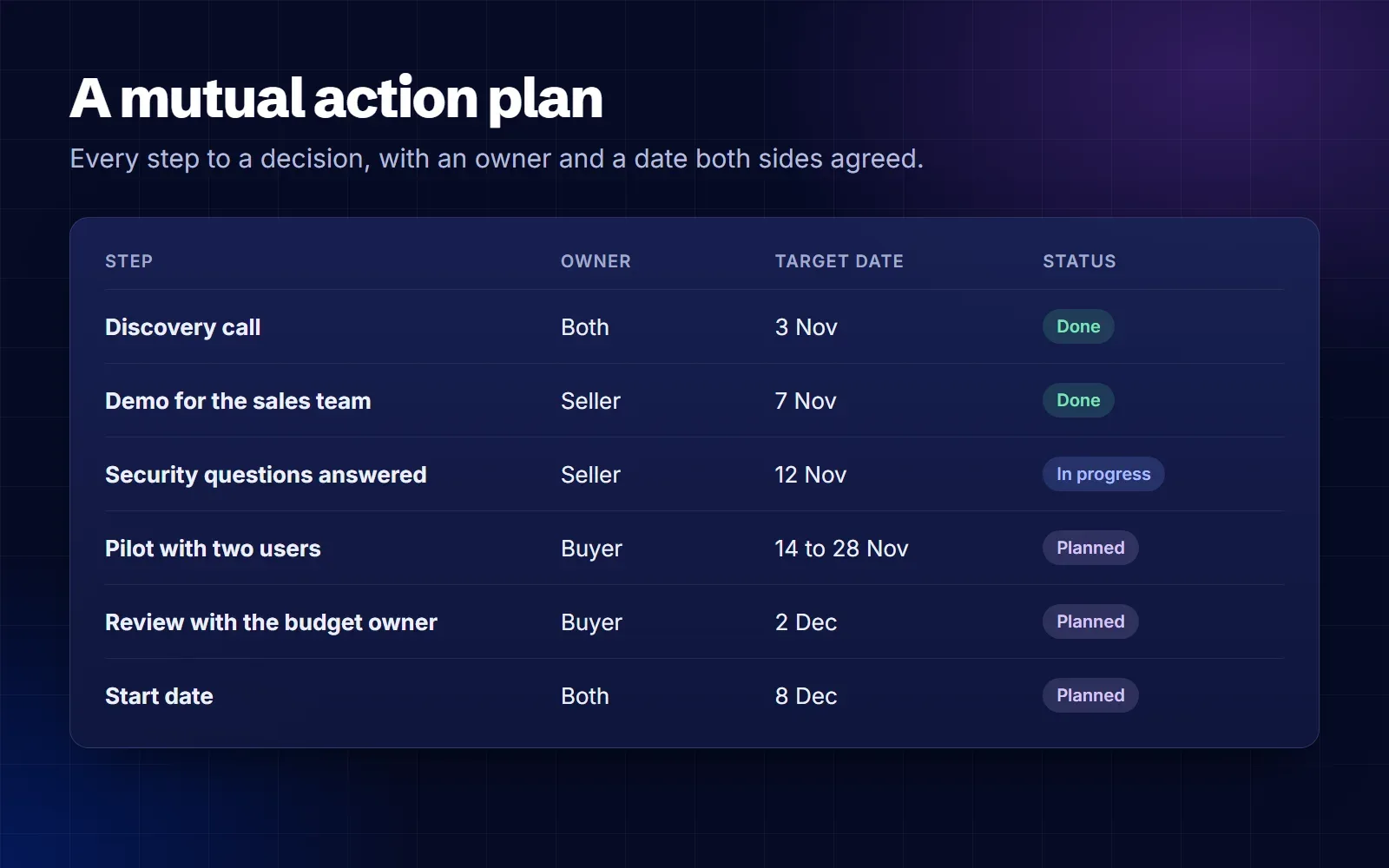
Preventing stalls is easier than fixing them. The most useful tool for this is a mutual action plan: a short, shared list of the steps both sides need to take before the buyer starts using your product, with owners and dates. It sounds formal, but for a small deal it can be five lines in an email.
Alongside the plan, a few habits shorten most sales cycles:
- End every call with a booked next step. Put it in the calendar before you hang up.
- Find the second and third contact by the second meeting. If you are still single threaded after two calls, that is your biggest risk.
- Agree the metric early. Write down the number the buyer expects to change, and use it in every follow up.
- Send recaps the same day. Short, in their words, with the next step at the top.
- Ask about the buying process in the first meeting. "What happened last time you bought a tool like this?" surfaces legal, security and budget steps before they surprise you.
A 30 minute weekly pipeline review
Once a week, go through every open deal with these questions. It takes about 30 minutes for a small pipeline and catches stalls while they are still easy to fix.
- When was the last buyer action, and what was it?
- Is there a next step with a date in the calendar?
- How many people at the account have we spoken to?
- What is the agreed metric, in the buyer's words?
- Has the deal been in this stage longer than twice the usual time?
- If we did nothing this week, would the deal move on its own?
Any deal that fails two or more of these needs a plan this week, or needs to come out of the forecast. If your pipeline is thin because too few meetings come in at the top, our guide on how to get more B2B sales meetings covers that side, and why B2B leads go cold after the first reply covers the earlier stage, before a deal even exists.
When should you walk away from a deal?
Walk away, or at least park the deal, when the buyer cannot name a problem worth solving this year, when there is no access to anyone who can approve the spend, or when three honest attempts to restart it get no real response. Close it in your CRM with the reason and a date to check back. Clean pipelines make better forecasts, and a parked deal with notes is much easier to restart than a forgotten one.
The same discipline applies at the top of the funnel. Leads that never fit your ideal customer profile tend to become deals that stall, because the problem was never urgent for them.
Where ZicReach helps
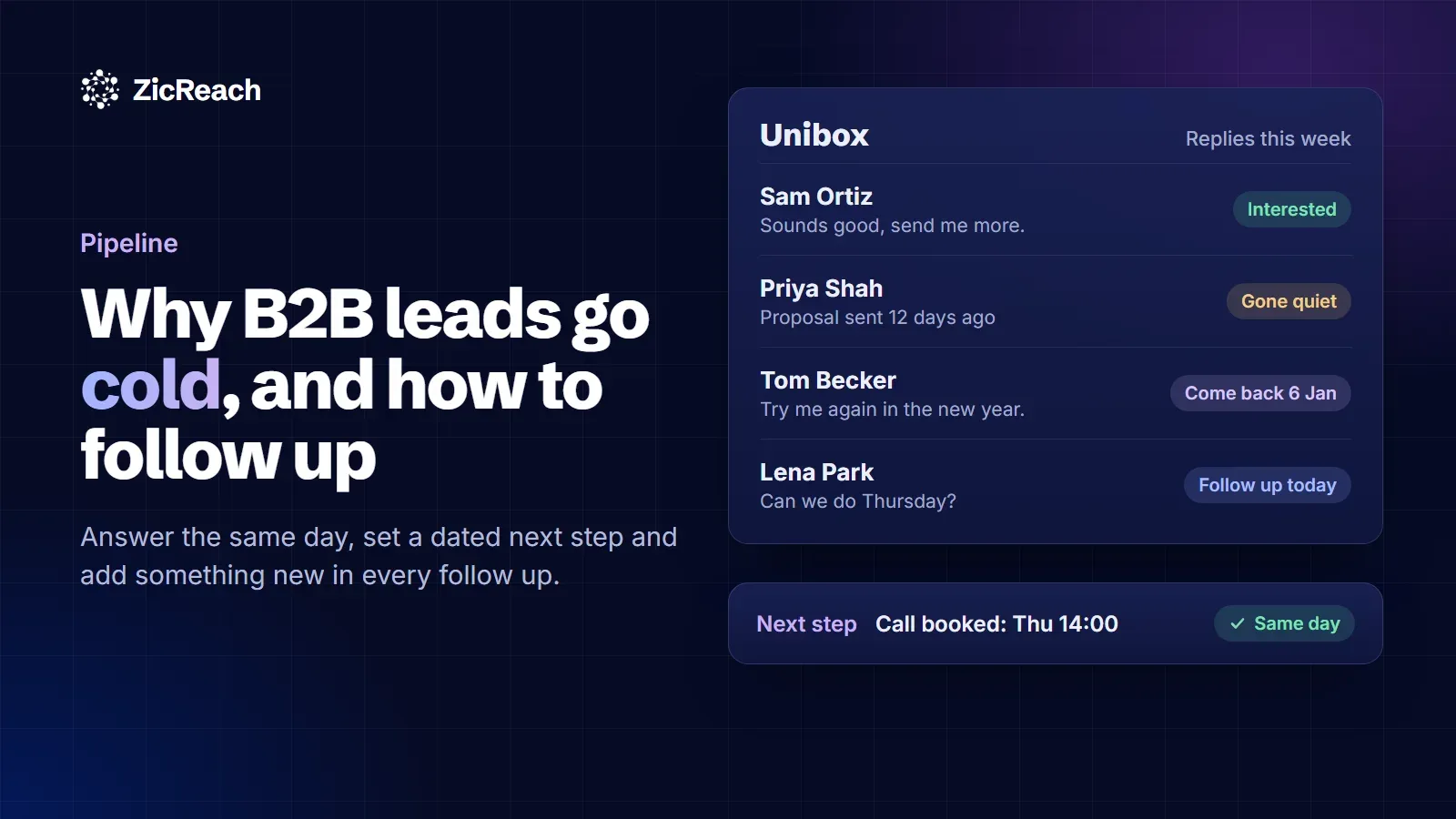
In ZicReach, Interested and meeting replies open an opportunity on a five stage CRM board automatically, so no deal starts life untracked. Notes are shared between the deal and the email thread, and Unibox views such as Gone quiet and Follow up today show the conversations that have stopped moving. Come back dates are read from replies like "let's talk after the budget review", so a parked deal resurfaces on time.
For the "give them something to forward" step, you can record a short screen and camera walkthrough in the browser and share a link that viewers can comment on. And if you want to check whether your pipeline numbers add up, the free cold email ROI calculator turns reply, meeting and close rates into revenue and cost per deal.
Questions people ask
Why do deals stall at the proposal stage?
Usually because the proposal went to one person who now has to get others to agree, often without the context from your calls. Offer a short call with the other people involved, and send a one page version they can read in two minutes.
How long is too long for a deal to sit in one stage?
A useful rule is twice the usual time for that stage. If deals normally move from demo to proposal in two weeks, a deal still at demo after four weeks with no buyer action is stalled.
What is a "no decision" loss?
It is a deal that ends without the buyer choosing anyone, including you or a competitor. Research behind The JOLT Effect found it accounts for 40% to 60% of deals, mostly because buyers fear making the wrong choice.
What is a mutual action plan?
A shared list of the steps both sides need to take before the buyer starts using your product, with an owner and a date for each. It keeps the deal moving and shows hidden steps, such as security review, early.
Should I offer a discount to close a stalled deal?
Rarely as a first move. Most stalled deals are about risk and uncertainty, not price. A smaller start, a pilot or an easy exit usually works better, and keeps your pricing intact.
The short version
Deals stall when nobody owns the next step, when one contact carries the whole decision, and when the buyer is afraid of choosing wrong. End every call with a dated next step, reach more of the buying group early, put the value in numbers, and make the decision smaller and safer. Review the pipeline weekly and close out the deals that have truly stopped.
To track every deal next to its email thread, start ZicReach for free. The pricing page shows what each plan includes.
Put this into practice with ZicReach
Find leads, write the sequence and send from warmed inboxes in one place. Free to start, no card needed.
Start for free