How to get more B2B sales meetings: fix the six leaks in your pipeline
More leads rarely fix a thin calendar. Good prospects fall out of the pipeline at six predictable points. Here is how to find them, close them, and keep them closed with a 30 minute weekly routine.
 By
9 min read
By
9 min read
When meetings dry up, the usual fix is more: more leads, more emails, more mailboxes, another tool. It feels productive, and for a week or two the activity numbers look great. Then the spam complaints rise, the reply rate falls, and the calendar looks the same as before.
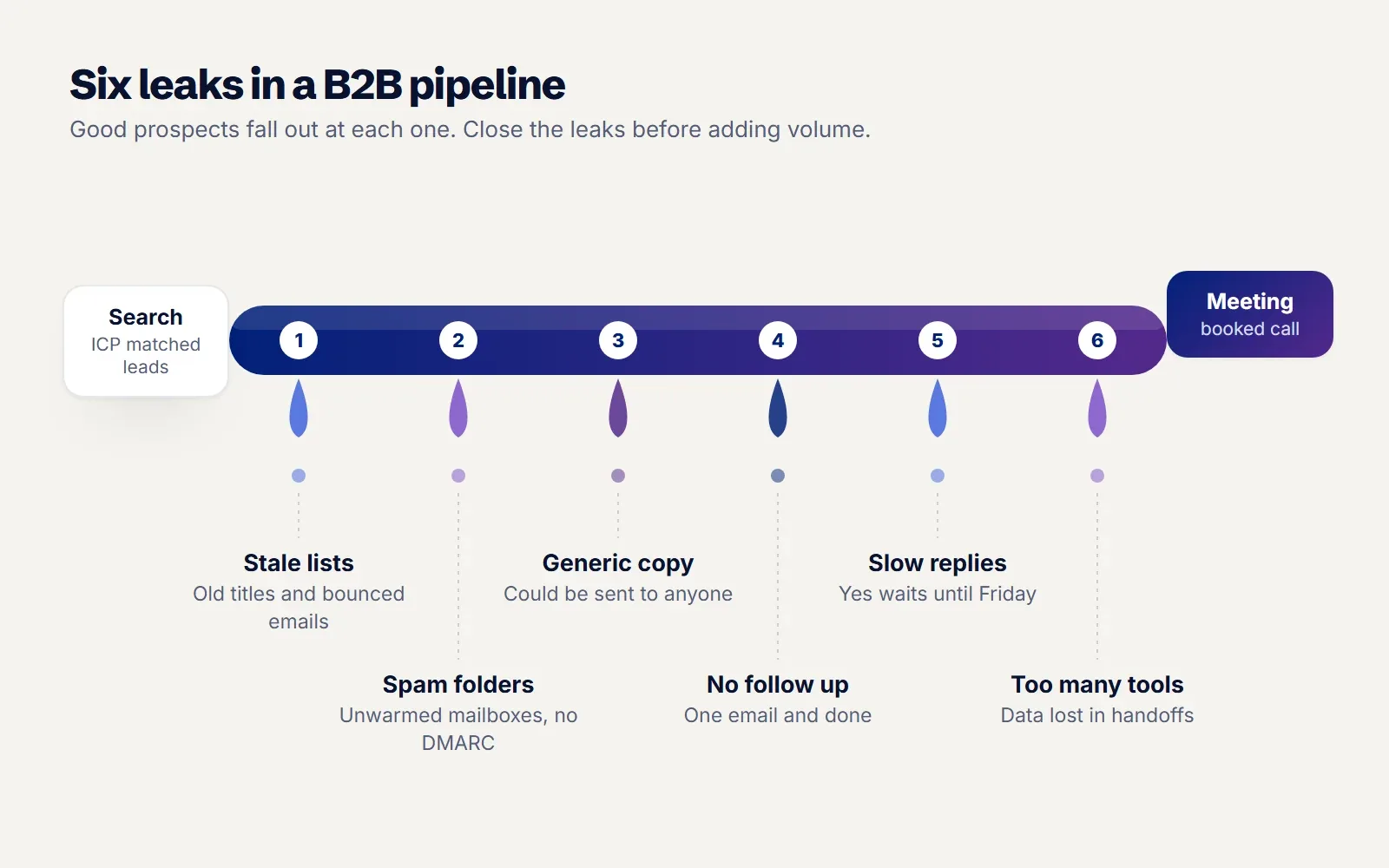
Most B2B teams do not have a volume problem. They have a leak problem. Good prospects fall out of the pipeline at six predictable points between "we found this company" and "they booked a call". Plug the leaks and the same effort produces more meetings. Pour more in without plugging them and you mostly make the holes bigger.
This guide covers why B2B pipelines run dry, the six leaks we see most often, and a weekly routine that keeps them closed.
Why B2B pipelines run dry
Two trends make every meeting harder to win than it was a few years ago.
First, buyers want less time with sellers. A Gartner sales survey published in March 2026 found that 67% of B2B buyers prefer a rep free buying experience. When a buyer does agree to talk, it is because the outreach was relevant and arrived at the right moment, not because it arrived often.
Second, sellers have less time to sell. Salesforce's State of Sales research found that reps spend just 28% of their time selling. The rest goes to data entry, research, deal admin and moving information between systems. A rep who spends the morning cleaning a spreadsheet is not writing to prospects.
Put those together and the job becomes clear: reach fewer, better fit people with something worth reading, and remove the busywork that eats the selling hours.
Leak 1: Your list goes stale
Every list starts decaying the day you export it. People get promoted, change companies and leave roles. The U.S. Bureau of Labor Statistics puts the median time with a current employer at 4.1 years, so a meaningful share of any B2B list changes every year. Old data costs you twice: bounced emails hurt your sender reputation, and the ones that do arrive reach someone who no longer owns the problem.
The fix starts before the list exists.
- Write down your ideal customer profile with at least four criteria: industry, company size, the role you sell to, and one signal that suggests timing, such as a relevant job posting, a new funding round or a tool they recently adopted.
- Grade every lead against it. Not every contact deserves the same effort. Score fit from strong to weak and spend your personal touches on the top grades.
- Enrich and verify right before you send, not months earlier. Work emails and job titles from last quarter are already partly wrong.
A list of 200 people who clearly match will usually book more meetings than 2,000 who loosely match, with far fewer complaints along the way.
Leak 2: Your emails never reach the inbox
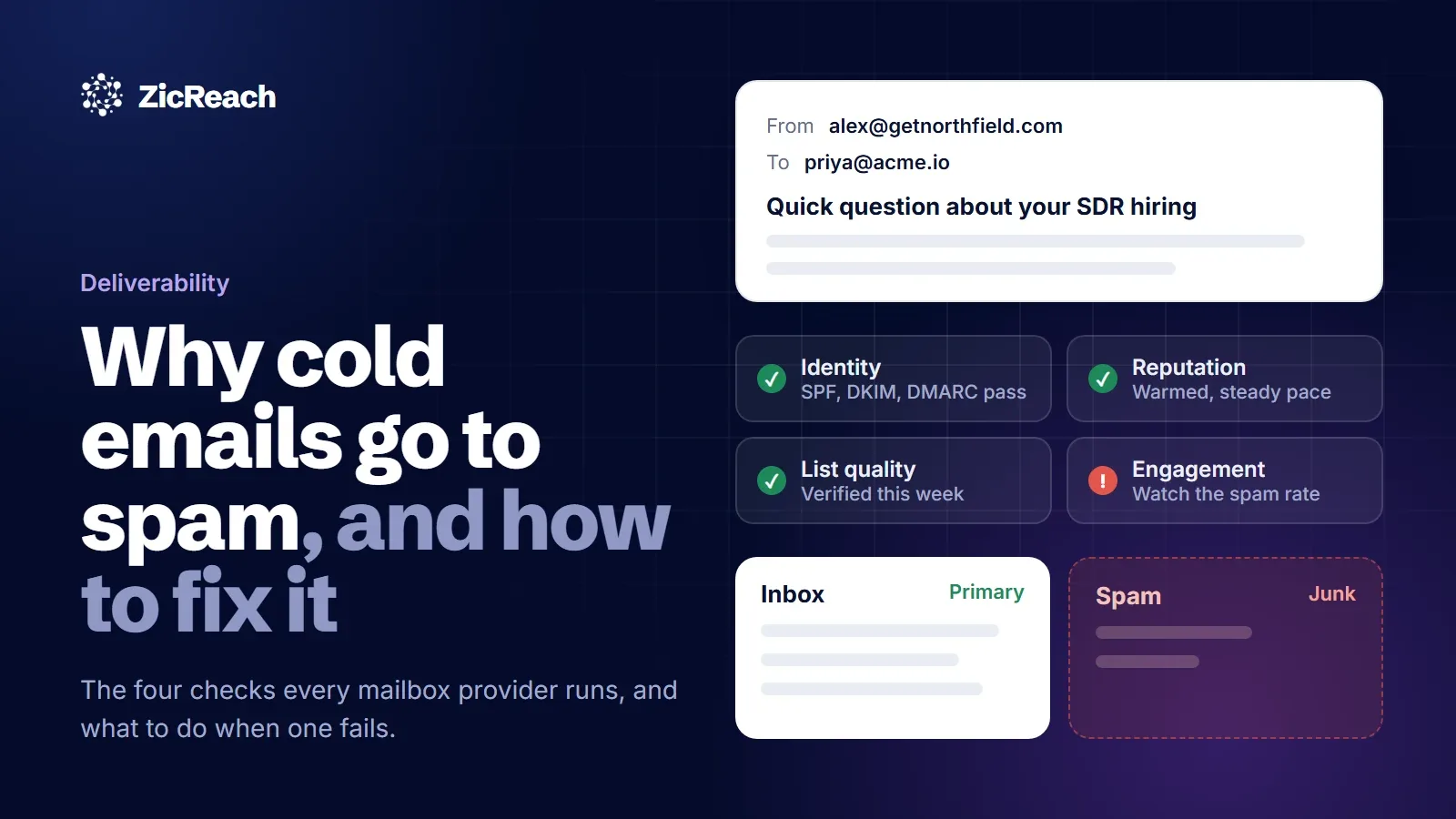
If a third of your emails land in spam, your real reply rate is a third higher than the one on your dashboard, and you are judging your copy on the wrong number. Missing SPF, DKIM and DMARC records, cold mailboxes, fast ramps and bounce heavy lists all push mail out of the inbox. Google now asks senders to keep their reported spam rate below 0.10%, and Microsoft routes mail that fails authentication from high volume senders to Junk.
This leak deserves its own guide, so we wrote one: why cold emails go to spam, and how to fix it. The short version is to authenticate your domain, warm up every mailbox, send at a modest pace from several mailboxes, and test placement before each campaign.
Leak 3: Your copy could be sent to anyone
Prospects can tell in one line whether an email was written for them. Backlinko's analysis of 12 million outreach emails found that personalizing the body of the email lifted responses by 32.7%, and personalized subject lines did about as well.
Personalization does not mean a compliment about their latest LinkedIn post. It means a reason. Why this company, why now, why you.
What a useful first email looks like
Here is the shape that tends to work, in under 90 words:
Hi Priya, saw that Northfield is hiring three SDRs in Austin. Teams that grow outbound that fast usually hit the same wall around month two: new mailboxes, low placement, replies scattered across inboxes. We help teams like yours keep every new mailbox warm and every reply in one place. Worth a 15 minute look next week, or not a priority right now?
One observation that is true and specific. One problem they probably have because of it. One sentence on what you do about it. One easy question. No attachments, no five bullet feature list, and an answer of "not now" is welcome.
Use AI for research, not for filler
AI is very good at the slow part: reading a company's site, job posts or news and pulling out the one fact that makes the email relevant. It is less good when asked to "write a personalized email" with nothing to go on, which is how inboxes fill with identical, oddly enthusiastic messages. Give the model the facts and your offer, then edit what it writes.
Leak 4: You stop after one email
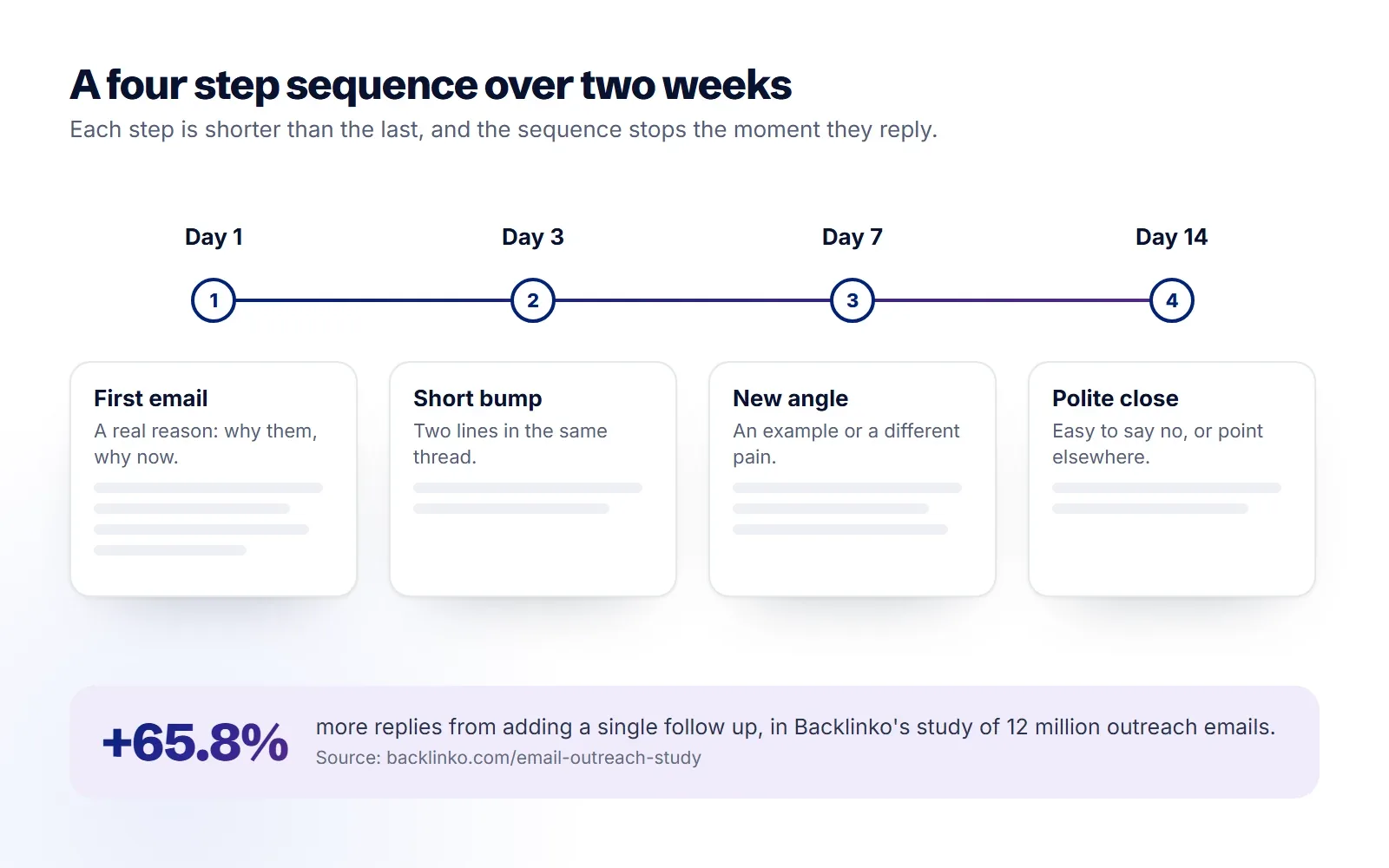
Many teams send a strong first email and then go quiet. The same Backlinko study found that a single follow up can boost replies by 65.8%, and sequences with three or more messages did better still. Busy people miss emails. A short, polite follow up a few days later catches the ones who meant to answer.
A follow up cadence that does not annoy
- Day 1: the first email, built around a reason.
- Day 3: a two line bump in the same thread. "Did this land at a bad time?" is enough.
- Day 7: a new angle. A short example, a relevant result or a question about a different pain.
- Day 14: a polite close that makes it easy to say no or to point you to the right person.
Stop the sequence for a person the moment they reply, book or opt out, across every campaign. Nothing kills goodwill faster than a "just following up" sent after someone already said yes.
Leak 5: Replies wait, or get lost across inboxes
A positive reply to a cold email is an inbound lead, and inbound leads cool down fast. In a study of 1.25 million sales leads published in Harvard Business Review, firms that tried to contact a lead within an hour were nearly seven times as likely to qualify it as those that waited even one hour longer, and more than 60 times as likely as those that waited 24 hours or more.
Outbound teams make this worse for themselves by spreading replies across many mailboxes. With ten sending accounts, an "interested, send me times" can sit unread in a mailbox nobody opens until Friday.
- Pull every reply from every mailbox into one inbox.
- Sort replies by intent, such as interested, neutral and not interested, so the hot ones rise to the top.
- Agree on a response time target for positive replies (the same morning is a good standard) and track it.
- Open a deal for every interested reply so it is visible in the pipeline, not buried in a thread.
Leak 6: Too many tools
A typical outbound stack has a data provider, an enrichment tool, a verifier, a warmup service, a sequencer, a shared inbox, a CRM and a few spreadsheets holding it together. Salesforce found that sales teams use an average of 10 tools to close deals, and 66% of reps feel overwhelmed by them.
Each handoff between tools is a chance to lose something: a lead exported without its latest title, an unsubscribe that never synced, a reply that never made it to the CRM. Each tool also brings its own login, its own bill and its own settings to keep in sync. Fewer tools, with the data flowing in one place, closes leaks you did not know you had.
A weekly pipeline routine
None of these fixes stick unless someone checks them. Thirty minutes a week is enough:
| Leak | Weekly check | Healthy sign |
|---|---|---|
| Stale lists | Are new leads enriched and verified within days of sending? | Hard bounces well under 2% |
| Spam folders | Mailbox health and the latest placement test | Healthy mailboxes, mostly inbox placement |
| Generic copy | Reply rate by campaign and by first line | The best campaign beats the average by a clear margin |
| No follow up | Share of replies coming from steps 2 to 4 | Follow ups bring in a large share of replies |
| Slow replies | Time from interested reply to your answer | Same morning, every time |
| Too many tools | Anything copied by hand between systems this week? | Nothing moved by hand |
How ZicReach closes the leaks
We built ZicReach because each of these leaks lived in a different tool. It puts the whole outbound loop in one workspace with one credit balance.
- Stale lists: the AI Leads Engine finds people, companies and open jobs, fills in work emails and phones through waterfall enrichment, and grades every lead from A to F against your business.
- Spam folders: AI Warmup is free for every mailbox, with a health score, domain checks and inbox placement tests.
- Generic copy and follow ups: AI Email Marketing drafts the sequence and its follow ups from what you tell it about your business, then sends from your own mailboxes in each lead's working hours.
- Slow replies: Unibox and CRM gather every reply in one inbox, tag them Interested, Neutral or Not interested, and open a deal for every yes.
- Too many tools: ZicAgent runs the busywork by chat, from building a list to setting up a campaign, and asks before it changes anything.
Questions people ask
What is a good reply rate for B2B cold email?
Backlinko's study of 12 million outreach emails found an average response rate of 8.5%, and many teams see lower numbers with broad lists. Rather than chase a benchmark, compare your own campaigns: tight targeting and a clear reason usually beat the average by a wide margin.
How many follow ups should a cold email sequence have?
Three follow ups after the first email, spread over about two weeks, is a sound default. Each one should be shorter than the last and add something new. Stop as soon as the person replies or opts out.
How quickly should I answer a positive reply?
Within the hour if you can, and the same morning at worst. Research on sales leads in Harvard Business Review found that the odds of qualifying a lead drop sharply after the first hour.
Is it better to send more emails or fewer, better ones?
Fewer, better ones, sent to people who clearly fit. More volume to a loose list raises bounces and spam complaints, which pushes all of your email toward the spam folder, including the emails to your best prospects.
How many leads do I need to book one meeting?
It depends on your market, offer and list quality, so measure your own funnel: leads contacted, replies, positive replies and meetings. Once you know your rates, you can work backwards from the number of meetings you need each month.
More meetings, same effort
Getting more B2B sales meetings is rarely about finding more people to email. It is about not losing the good ones you already have: a list that is current and graded, emails that reach the inbox, copy with a real reason, follow ups that catch busy people, replies answered the same morning, and a stack simple enough that nothing falls between tools.
Pick the leak that costs you the most this month and fix that one first. If you want to see all six in one place, start ZicReach for free, run one search and see which of your leads grade A. The pricing page shows what each plan includes.
Put this into practice with ZicReach
Find leads, write the sequence and send from warmed inboxes in one place. Free to start, no card needed.
Start for free