How to personalize cold emails at scale without sounding like a robot
If you can swap the first line for another prospect's and the email still makes sense, it was never personal. How to personalize the reason for writing, brief AI to sound human, and spend real research time only where it pays.
 By
9 min read
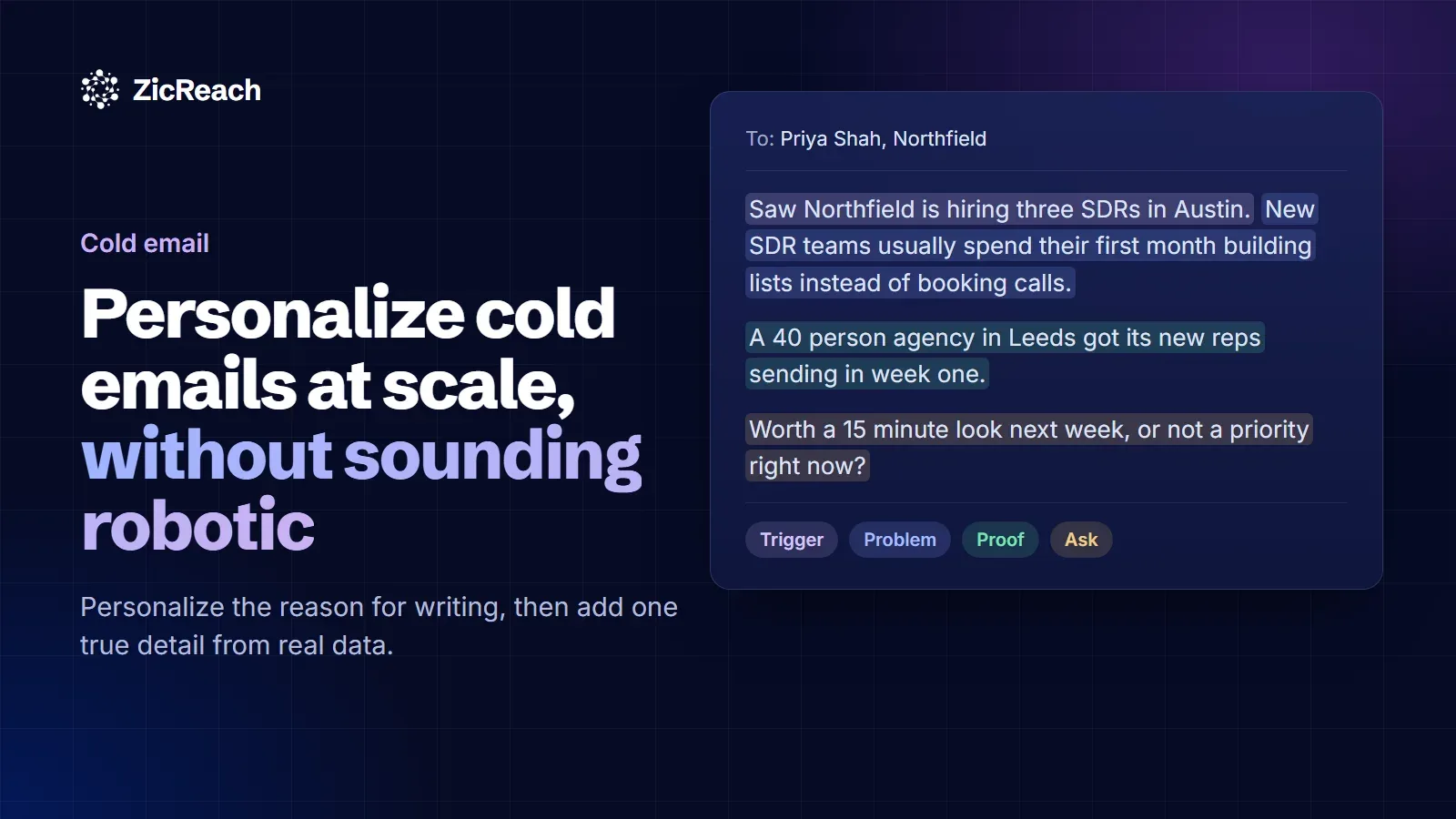
To personalize cold emails at scale without sounding robotic, personalize the reason you are writing, not just the first line. Group leads by a shared, specific trigger, write one strong email for that group, then add one true detail per person from real data about them. AI can do the last step for thousands of leads, but only when it works from facts about each lead and a tight brief, not from a name and a company website.
Most "personalized" cold email fails the same test: if you swap the first line for another prospect's, does the email still make sense? If it does, the personalization was decoration. Buyers can tell, and they treat it like any other mass email.
Why does personalized cold email still sound robotic?
Because most of it is written backwards. A template is written for everyone, then a line is bolted on top: "I loved your recent post on leadership" or "Congrats on the growth at Acme". The line has nothing to do with the rest of the email, so it reads as a trick.
Three patterns give it away:
- Flattery about public facts. Complimenting someone on their job title or their company's homepage tells them you looked for five seconds.
- Personal detail, generic pitch. The first line is about them; everything after it could be sent to anyone.
- Machine phrasing. "I hope this email finds you well", "I came across your profile", "I wanted to reach out" and long, perfectly balanced sentences. AI writers produce these by default unless told not to.
Real personalization is not about how much you know about someone. It is about whether your reason for writing is specific to their situation.
Key numbers
| Number | What it tells you | Source |
|---|---|---|
| 32.7% | Lift in response rate for emails with a personalized message body. | Backlinko, 12 million outreach emails |
| 30.5% | Lift in response rate for personalized subject lines. | Backlinko |
| 3.43% | Average cold email reply rate. The top 10% of campaigns pass 10.7%. | Instantly benchmark report 2026 |
| Under 80 words | Typical length of first emails in the best performing campaigns. | Instantly benchmark report 2026 |
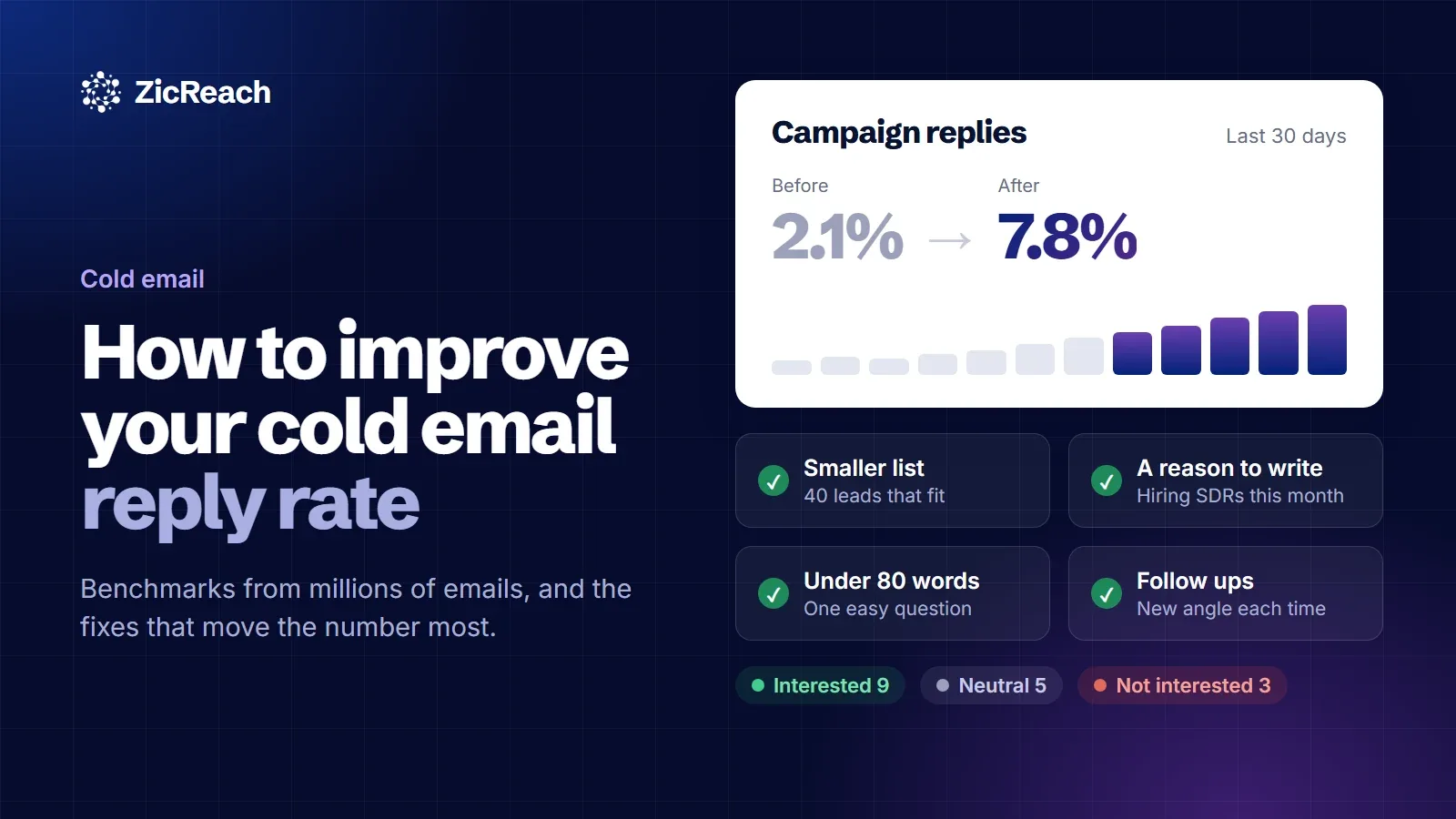
| 5.8% vs 2.1% | Reply rate for campaigns under 50 recipients against campaigns of 1,000 or more. | Woodpecker |
The pattern across these studies is consistent: smaller, more relevant sends beat big generic ones, and personalization pays when it changes what the email says, not just how it opens.
What are the levels of cold email personalization?
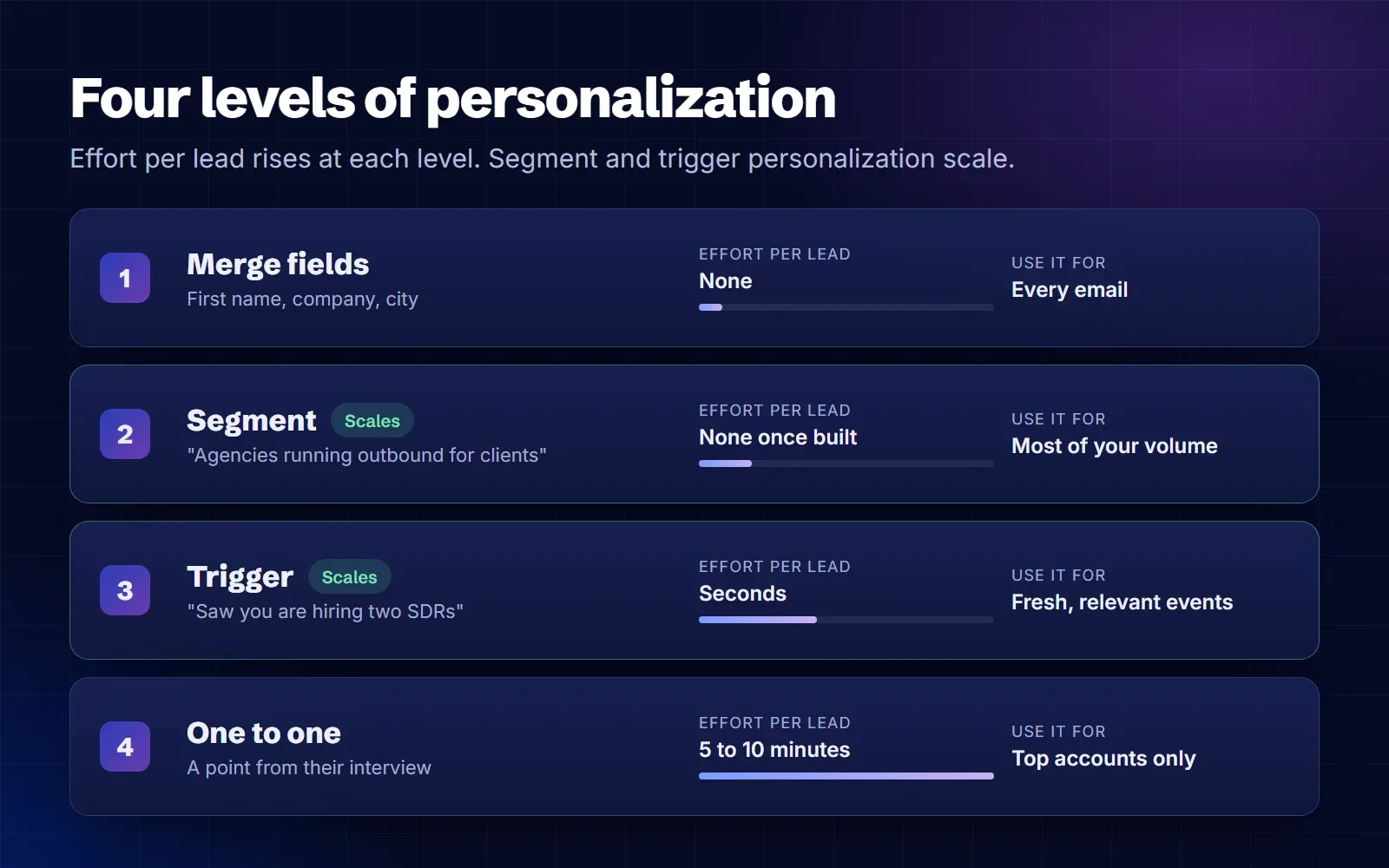
It helps to think of personalization as four levels, each with a different cost and a different place in your outreach.
| Level | Example | Effort per lead | Use it for |
|---|---|---|---|
| 1. Merge fields | First name, company name, city | None | Every email, as a baseline |
| 2. Segment | "Agencies running outbound for three or more clients" | None once the list is built | Most of your volume |
| 3. Trigger | "Saw you are hiring two SDRs in Leeds" | Seconds, if the data is in your list | Leads with a fresh, relevant event |
| 4. One to one | A point from their podcast interview, tied to your offer | 5 to 10 minutes | Your best accounts only |
The mistake is trying to do level 4 for everyone, running out of time, and falling back to level 1. Most of the reply lift comes from levels 2 and 3, which scale.
What should you personalize in a cold email?
Personalize the three parts that decide whether someone replies:
- The reason for writing. Why this person, why now. A trigger such as a new role, a hiring push, a funding round or a tool change gives you an honest reason.
- The problem. Name the problem the way someone in their role would describe it. A head of sales and a founder feel the same issue differently.
- The proof. A result from a company like theirs, in their industry or at their size, is worth more than any compliment.
Leave the rest simple. A short, clear ask and a normal sign off do not need personalizing.
How do you personalize cold emails at scale? Step by step
- Segment by trigger, not just by industry. "SaaS companies, 50 to 200 people" is a market. "SaaS companies that started hiring SDRs this month" is a segment with a reason to write. Our guide on ideal customer profiles and lead scoring shows how to find these timing signals.
- Collect the facts as columns. For each lead, store what you would want to mention: the open role, the recent news, the tool they use, a line from their site. Personalization is only as good as the data under it.
- Write one strong email per segment. Under 80 words, plain text, one problem, one proof point, one easy question. Leave a slot for one personal line.
- Give the AI, or your team, rules for that slot. Use only facts from the columns. One sentence, no compliments, no "I noticed". Connect the fact to the problem in the email. If there is no good fact, leave the line out.
- Read 20 before you send 2,000. Check a sample for wrong facts, awkward phrasing and lines that would make sense in anyone's email. Fix the rules, not just the examples.
- Test one change at a time. Compare a version with and without the personal line, or two different triggers, on similar groups. Judge by positive replies, not opens.
- Feed replies back in. When people answer, look at which segment and which line they responded to. That tells you where to spend more effort next time.
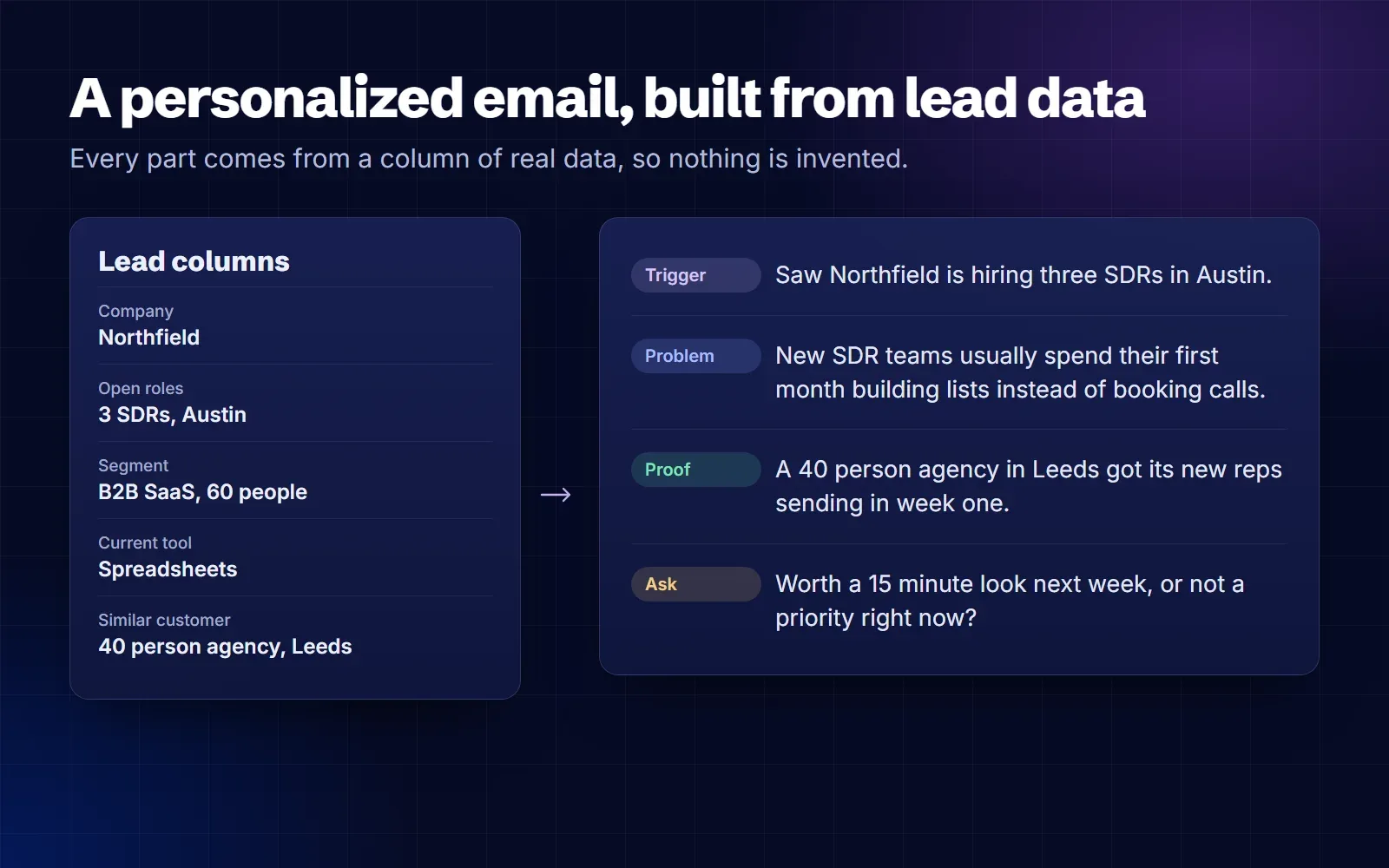
What does good personalization look like? Generic vs specific
| Generic | Specific |
|---|---|
| "I came across Northfield and was impressed by your growth." | "Saw Northfield is hiring three SDRs in Austin." |
| "Many companies struggle with lead generation." | "New SDR teams usually spend their first month building lists instead of booking calls." |
| "We help businesses like yours achieve their goals." | "A 40 person agency in Leeds used this to get its new reps sending in week one." |
| "Would you be open to a 30 minute call to explore synergies?" | "Worth a 15 minute look next week, or not a priority right now?" |
Notice that the specific versions are not longer. They are just about something real. That also keeps them short, which matters: the best performing campaigns in the Instantly 2026 benchmark kept first emails under 80 words.
How do you brief AI to write personal lines that sound human?
AI writers are fast and tireless, which is exactly why a weak brief is dangerous: the same mistake goes out a thousand times. The brief matters more than the model. A good one is short and concrete, and it says what not to do as clearly as what to do. Here is an example for a segment of companies hiring SDRs:
Write one sentence, under 20 words, that connects the open role in the "hiring" column to the problem of new reps spending their first month building lists. Use only facts from the columns. No compliments, no "I noticed" or "I came across", no exclamation marks. If the hiring column is empty, return nothing.
Three things make this brief work. It names the exact data to use, so the AI cannot invent a detail. It ties the line to the problem in the email, so the personalization leads somewhere. And it has an escape hatch, so a lead with no good fact gets a clean segment email instead of a forced line. When you review your sample of 20, read each line out loud. If you would not say it to the person on a call, change the rule that produced it.
Which personalization mistakes make emails worse?
- Wrong facts. Congratulating someone on a role they left last year is worse than no personalization. Use recent data; our guide on finding verified business email addresses explains why lists go stale so fast.
- Creepy detail. Mentioning someone's family, holiday or personal social posts. Stick to their work and their company.
- Personalization that does not connect. A line about their podcast followed by a pitch for something unrelated.
- Spammy wording. Overexcited copy, too many links and heavy formatting hurt delivery. Our guide on why cold emails go to spam covers the content signals filters look at.
- Too much volume per mailbox. Even great copy fails if a new mailbox sends hundreds a day. See how long to warm up an email domain for a safe ramp.
How much time should you spend personalizing each email?
Match the effort to the value of the lead. A simple rule that works for small teams:
- Top accounts (grade A): five to ten minutes each. Read their site and recent news, write a personal first line by hand, and reach two or three people. Backlinko found that outreach to multiple contacts at an organization lifted response rates by 93%.
- Good fit (grade B): segment and trigger personalization, with an AI written line from your columns, checked on a sample.
- Everyone else: do not email yet. Wait for a trigger, or improve the list.
This is how you scale without sounding like a robot: most emails get an honest, specific reason to write, and your best prospects get the extra care.
If replies are still low after personalization, the problem may be elsewhere. Our guide on improving your cold email reply rate covers the other fixes in order, and how to qualify leads before a sales call helps you spend your call time on the replies that matter. When someone answers and then goes quiet, use this follow up process.
Where ZicReach helps
In AI Email Marketing, AI can write a personalised email for each prospect at the moment it is sent, inside your sequence, using every column of the lead (job title, company, recent news, tech stack) and the details you gave in AI Training. Merge fields have fallbacks, such as a default greeting when a first name is missing, and a spam word check flags risky phrasing before you send.
To fill the columns, AI columns in the AI Leads Engine run a prompt on every row, such as "What are they hiring for?" or "Which CRM do they use?". And before you send to real people, the AI Simulator lets you test two versions of the copy on AI prospects built from your audience, to see which one reads as more relevant. You can also paste any draft into the free spam word checker.
Questions people ask
Does personalization really improve cold email reply rates?
Yes, when it changes what the email says. Backlinko found personalized message bodies lifted responses by 32.7%. A first line that has nothing to do with the rest of the email rarely helps.
Is AI personalization good enough for cold email?
It can be, if the AI writes from real data about each lead and clear rules, such as one sentence, no compliments, only facts from the columns. Always read a sample before a full send, because AI repeats the same mistake at scale.
What is a personalized first line?
It is an opening sentence that could only be sent to that person, usually tied to a recent event at their company or something they said in public about their work. The best ones lead straight into the problem the email is about.
How long should a personalized cold email be?
Short. The best performing first emails in the Instantly 2026 benchmark were under 80 words. Personalization should replace generic sentences, not add to them.
Can personalization be too much?
Yes. Details about someone's private life, very old information or a long list of things you found about them feel intrusive. Keep it to one relevant, recent, work related fact.
The short version
Personalize the reason, the problem and the proof, not just the greeting. Build segments around triggers, keep the facts as columns, write one short email per segment with one slot for a true personal line, and check a sample before every big send. Spend real research time only on your best accounts.
To write each email from your own lead data when it is sent, start ZicReach for free. The pricing page shows what each plan includes.
Put this into practice with ZicReach
Find leads, write the sequence and send from warmed inboxes in one place. Free to start, no card needed.
Start for free