Why B2B leads go cold after the first reply, and how to follow up
Most leads that go quiet after a first reply were not lost to a competitor. They were answered too late, given a vague next step, or left with one contact who could not decide. Here is why it happens and a follow up plan that brings them back.
 By
11 min read
Most B2B leads go cold after a first reply for three reasons: the answer came too late, the next step was vague, or the person who replied could not move the deal on their own. Fix those three with a same day answer, one specific next step with a date, and a follow up plan that adds something new each time, and a good share of "ghosted" leads come back.
That is the short answer. The longer one matters because a lead that replied once is the most expensive thing in your pipeline. You paid for the data, the mailboxes, the copy and the weeks of warmup that got the email delivered. Losing that person to silence is not bad luck. It is usually a process gap you can close.
What does it mean when a lead goes cold?
A lead has gone cold when they showed interest and then stopped responding, without saying no. They answered your cold email, maybe agreed to "take a look", maybe even booked a call, and then nothing. No reply to your follow up, no show on the calendar, no answer to the proposal.
It helps to separate three situations, because each one needs a different follow up:
- Cold after the first reply. They said something like "sounds interesting, send me more" and went quiet.
- Cold after a meeting. The call went well, you sent a recap or a proposal, and the thread died.
- Cold after "not right now". They told you the timing was wrong. That is not a cold lead yet; it becomes one only when you forget to come back.
Key numbers
| Number | What it means for follow up | Source |
|---|---|---|
| Nearly 7 times | Firms that tried to contact a lead within an hour were nearly seven times as likely to qualify it as those that waited even an hour longer. | Harvard Business Review |
| 65.8% | A single follow up lifted replies by 65.8% in a study of 12 million outreach emails. | Backlinko |
| 42% | Share of cold email replies that come from follow ups rather than the first email. | Instantly benchmark report 2026 |
| 67% | Share of B2B buyers who prefer a buying experience without a sales rep. | Gartner, March 2026 |
| 28% | Share of a sales rep's week spent actually selling. | Salesforce State of Sales |
Why do B2B leads go cold after they reply?
When we look at threads that died, the same seven causes come up again and again. Usually more than one is at work.
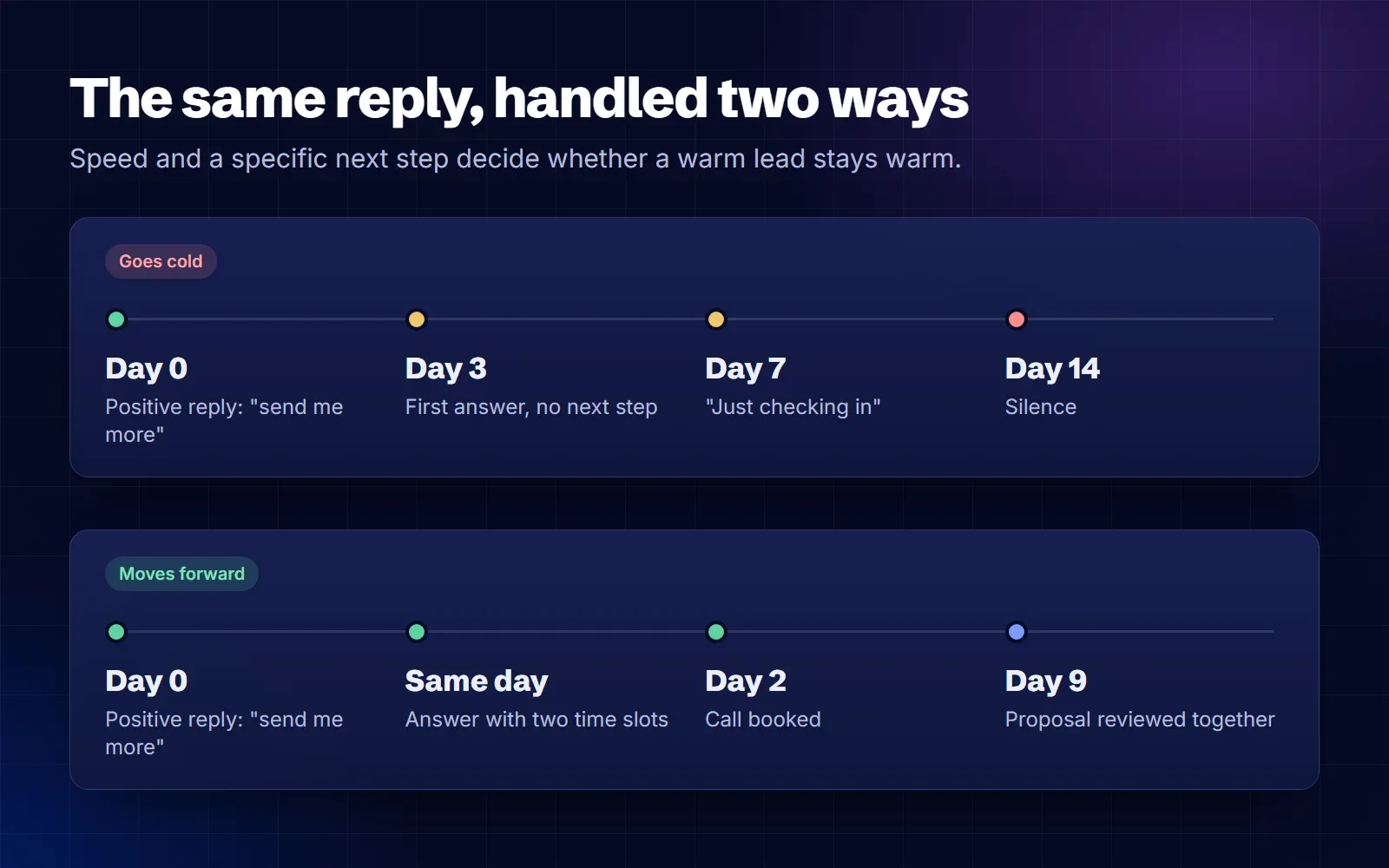
1. You answered too slowly
Interest fades fast. In a study of 1.25 million sales leads published in Harvard Business Review, firms that tried to contact a lead within an hour were nearly seven times as likely to qualify it as those that waited even one hour longer, and more than 60 times as likely as those that waited a day or more. That research was about inbound web leads, but the lesson carries over to cold email replies: the moment someone answers is the moment they are thinking about the problem. Two days later they are thinking about something else.
Slow answers are rarely laziness. More often the reply landed in a mailbox nobody checks, or it sat behind a pile of out of office messages and unsubscribes.
2. The next step was vague
"Happy to chat whenever suits you" puts all the work on the buyer. They have to decide when, how long, and what the call is for. Many will mean to reply and never do. A specific offer, such as two time slots or a 15 minute call to look at one question, is far easier to say yes to.
3. The person who replied cannot decide alone
B2B purchases are made by groups. Gartner's research on B2B buying has long put the typical buying group for a complex purchase at six to ten people. Your contact may like the idea and still be unable to move it forward without a manager, a budget owner or the people who would use the tool. When they go quiet, it is often because they hit that internal wall and did not know how to tell you.
4. The timing changed
A reorganization, a quarter end, a holiday, a hiring freeze. None of these mean "no", but all of them push your thread to the bottom of the pile. If you treat silence as rejection, you lose leads who would have bought three months later.
5. Your follow ups add nothing
"Just checking in" and "bumping this to the top of your inbox" give the reader no new reason to answer. Each follow up should bring something: an answer to a likely question, a short example, a relevant number, a simpler next step.
6. You made it hard to buy without you
Buyers do more of their research alone than they used to. A Gartner sales survey published in March 2026 found that 67% of B2B buyers prefer a rep free buying experience. If the only way to learn more is to book a call, some interested people will simply stop. Pricing they can see, a short recorded walkthrough and a page they can forward to a colleague keep them moving when they are not ready to talk.
7. Nobody owns the follow up
Sellers are stretched. Salesforce's State of Sales research found that reps spend just 28% of their time selling. When replies come into several mailboxes and nobody is clearly responsible for each one, follow ups slip by days, then weeks. The lead did not go cold. It was left out.
How can you tell if a lead is warm, cooling or cold?
Before you write a follow up, work out where the lead really stands. The right message for a lead that is cooling is very different from the right message for one that has been silent for two months.
| Status | Typical signals | What to send |
|---|---|---|
| Warm | Replied in the last few days, asked a question, named a date or a colleague | A same day answer with one specific next step and two time options |
| Cooling | No reply to your last message for 5 to 10 days, but the thread was positive | A short follow up that adds one useful thing and makes the next step smaller |
| Cold | Silent for 3 weeks or more after showing interest | A fresh angle: a new trigger, a different contact, or a direct "should I close this?" question |
| Parked | Said "not now" and gave a time, such as "after Q1" | Nothing until that date, then a message that refers back to their own words |
| Closed | Said no, asked you to stop, or bounced | Nothing. Respect it and remove them from every sequence |
How do you follow up with a lead that went cold? Step by step
This is the process we use and recommend. It works for leads that went quiet after a first reply and after a meeting.
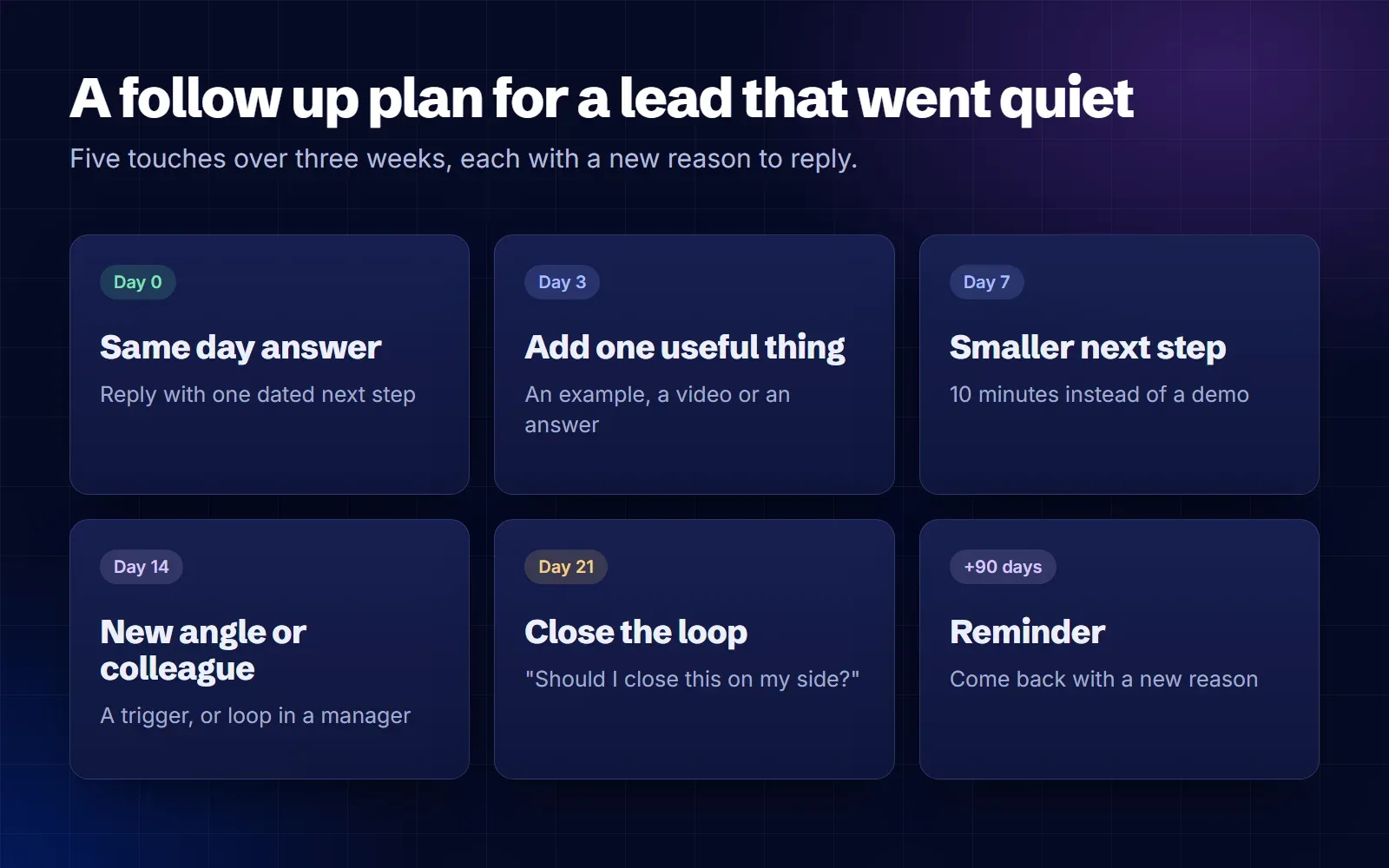
- Reread the whole thread. Note exactly what they said, what they asked, and the last thing you promised. Most weak follow ups come from not remembering the conversation.
- Find the likely reason for the silence. Was the next step vague? Did they mention a colleague or a deadline? Did your last message ask for too much? Your follow up should address that reason.
- Add one new thing. A short answer to a question they did not ask yet, a two line example from a similar company, a recorded walkthrough, or a relevant change at their company, such as a new hire or a funding round.
- Shrink the next step. If a 30 minute demo felt like too much, offer a 10 minute call, a two minute video or a one page summary they can forward.
- Space your follow ups. Leave three or four working days between the first few messages, then a week or more. Instantly's benchmark report suggests spacing touches three to four days apart, and in our experience that holds for warm leads too.
- Widen the thread when it makes sense. If your contact mentioned a manager or a colleague, ask whether it would help to include them. Do not go around your contact without telling them.
- Close the loop. After three or four unanswered follow ups, send a short, honest message asking whether to close the file. Then set a reminder for a few months out and move on.
What should a follow up to a cold lead say?
Good follow ups are short, refer to what the person actually said, and end with a question that is easy to answer. Here are three that work, adapted to the situation.
After a first reply that went quiet:
Hi Sam, you mentioned onboarding new reps was the slow part. Here is a two minute video of how one team cut it from three weeks to one. If it looks relevant, would Tuesday at 10 or Thursday at 2 work for a quick call?
After a meeting and a proposal:
Hi Priya, I know proposals tend to stall when someone else needs to sign off. Would it help if I sent a one page version for your finance lead, or joined a 15 minute call with them?
Closing the loop:
Hi Tom, I have not heard back, so I will assume the timing is not right and close this on my side. If things change later in the year, just reply here and I will pick it up.
That last message often gets the most replies of the whole sequence, because it is honest and asks for nothing. Some people answer "please do follow up in March", which turns a cold lead into a parked one with a date.
How many times should you follow up before you stop?
For a lead that showed real interest, four or five follow ups over about three weeks is reasonable, as long as each one adds something. Backlinko found that a single follow up lifted replies by 65.8%, and the 2026 Instantly benchmark found that 42% of cold email replies come after the first email. Giving up after one unanswered message leaves a lot on the table.
Past that point, more chasing does more harm than good. It annoys people, and if they start marking you as spam it hurts the deliverability of every other email you send. Our guide on why cold emails go to spam explains how complaints feed into filtering. Stop, set a reminder, and come back later with a new reason.
How do you stop leads going cold in the first place?
Rescuing cold leads is useful. Not losing them is better. Four habits prevent most of the problem:
- Answer positive replies the same working day. Put every reply from every mailbox in one place and check it at fixed times, at least twice a day.
- End every message with a dated next step. "Thursday at 2 or Friday at 10?" beats "let me know".
- Write down come back dates. When someone says "after the summer", record the date and the exact words, so the follow up can quote them.
- Give each lead one owner. If two people might answer, nobody will.
It also helps to send to the right people in the first place. Leads that fit your ideal customer profile and have a real trigger go cold far less often; our guide on building an ideal customer profile and scoring leads shows how to sort them. And if your problem is fewer replies to begin with, start with how to improve your cold email reply rate and how to get more B2B sales meetings.
Where ZicReach helps
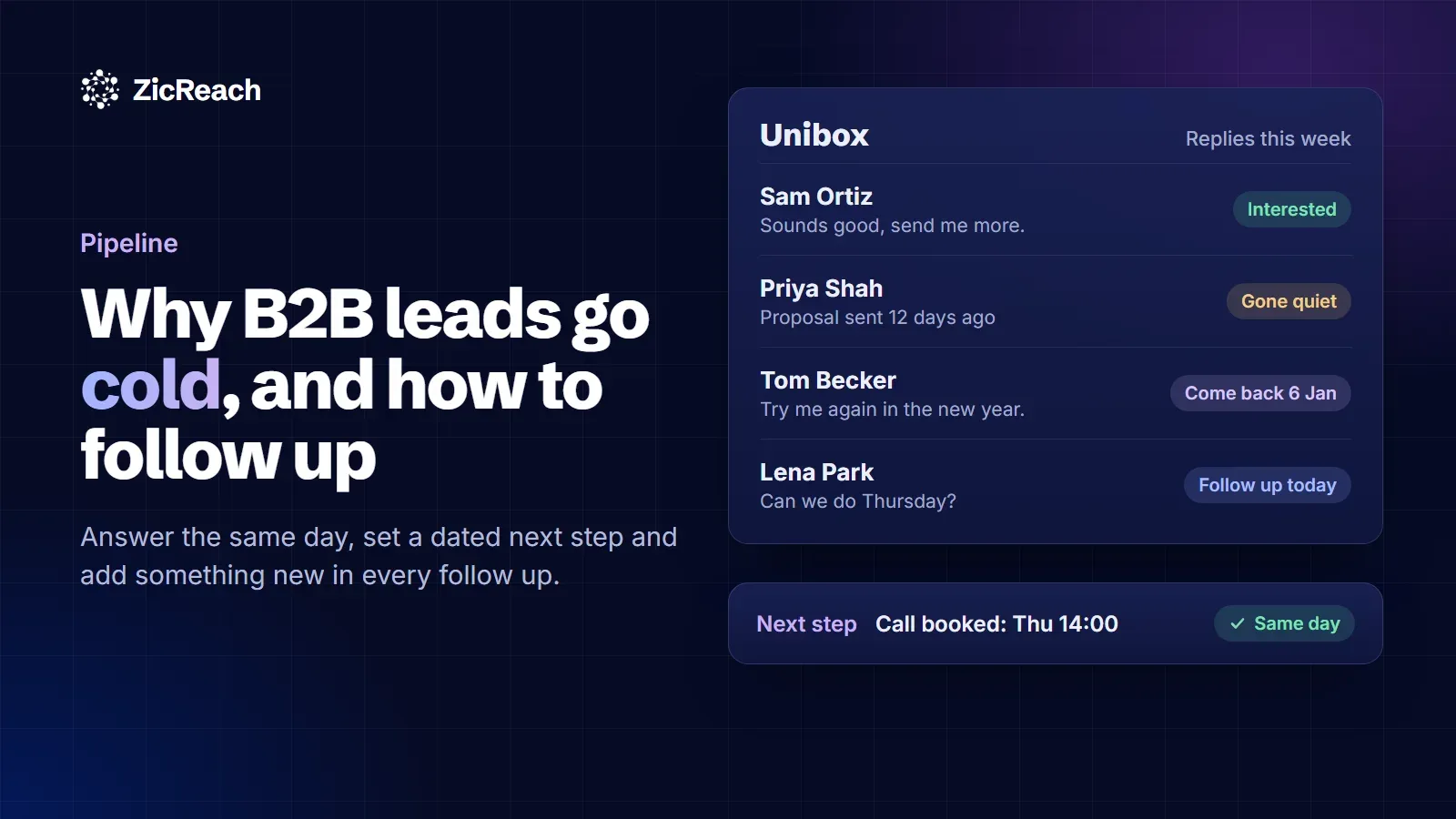
In ZicReach, every reply from every connected mailbox lands in one inbox, Unibox, and is tagged Interested, Neutral or Not interested. Views such as Follow up today and Gone quiet show which leads need attention, and come back dates are read from replies like "try me in March", so they resurface on their own. Interested and meeting replies open an opportunity on the CRM board automatically, with notes shared between the inbox and the deal.
For follow ups that need more than text, you can record a short screen and camera video in the browser and send the link. And sequences in AI Email Marketing keep the first email and every follow up in the same thread, stopping as soon as someone replies.
Questions people ask
Why do leads go cold after showing interest?
Most often because the answer came late, the next step was vague, or the person needed someone else to agree and stalled. Changes in timing, such as a reorganization or a quarter end, cause the rest. Very few go quiet because they decided against you.
How long should I wait before following up with a cold lead?
Answer a positive reply the same working day. If a warm lead goes quiet, wait three or four working days before the first follow up, then about a week between later ones.
How many follow ups are too many?
For an interested lead, four or five follow ups over about three weeks is plenty, if each adds something new. After that, send a short message offering to close the file, and set a reminder for a few months later.
Should I call or email a lead that has gone cold?
Use whatever channel they used with you first, and add a second one only if it fits how they work. A short recorded video is a good middle ground: personal, quick to watch, and easy to forward to a colleague.
What is a breakup email, and does it work?
A breakup email is a short final message saying you will close the conversation unless they want to continue. It works because it is honest and easy to answer, and it often brings back a date to follow up on.
The short version
Leads go cold when answers are slow, next steps are vague, and nobody owns the follow up. Answer the same day, end every message with a dated next step, add something new in each follow up, and close the loop politely after three weeks. Record every "not now" with its date, and come back when you said you would.
To keep every reply and every come back date in one place, start ZicReach for free. The pricing page shows what each plan includes.
Put this into practice with ZicReach
Find leads, write the sequence and send from warmed inboxes in one place. Free to start, no card needed.
Start for free