How to build an ideal customer profile and score leads for outbound
Most ICPs describe a market, not a customer. Build yours from deals you have won in three layers (company fit, person fit and timing), then turn it into a lead score with grades your team can act on.
 By
10 min read
By
10 min read
Ask a sales team who their ideal customer is and you will often hear something like "B2B software companies, 50 to 500 people, in the US and UK". That describes tens of thousands of companies. Most of them will never buy, a few might buy next year, and a small handful would say yes this month if the right person wrote to them about the right problem.
An ideal customer profile (ICP) is how you find that handful. Lead scoring is how you make the profile useful every day, so a rep opening a list of 2,000 names knows which 200 to write to first and which 800 to skip. This guide walks through building both from your own data, with a scorecard you can copy and the mistakes that make most ICPs useless.
ICP, persona and target market: what is the difference?
Three terms get mixed up, and the confusion leads to vague lists:
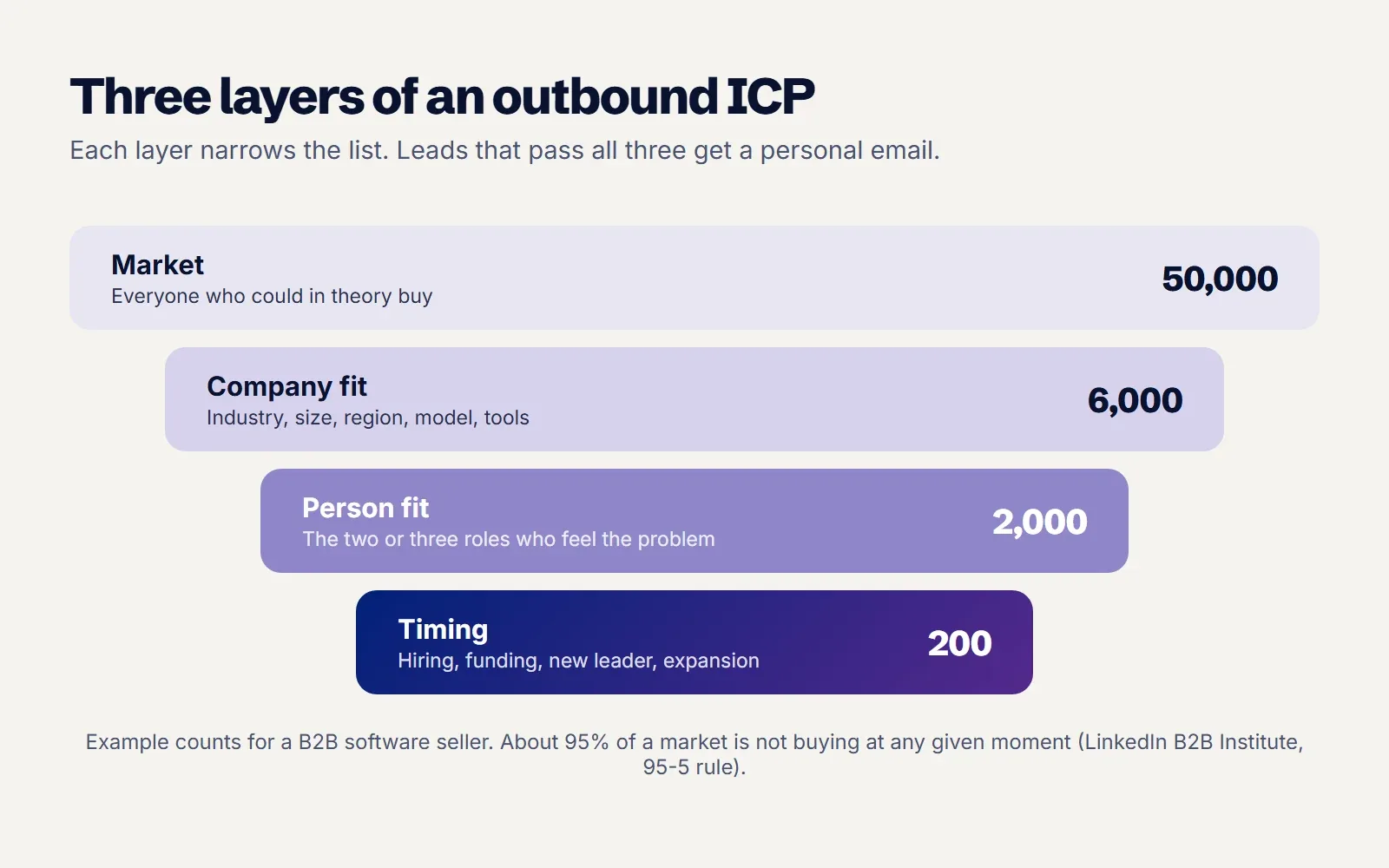
- Total addressable market is everyone who could in theory buy from you. It is a number for investors, not a list for outreach.
- Ideal customer profile describes the companies most likely to buy, succeed and stay: their size, industry, model, tools and situation.
- Buyer persona describes the people inside those companies: their role, what they are measured on and the problems that keep them busy.
Outbound needs all three layers plus a fourth that most ICP guides skip: timing. A perfect fit company that is not dealing with the problem right now will not reply, however good your email is.
Step 1: Start from the customers you already won
Do not start with a brainstorm. Start with evidence. Pull your closed won deals from the last 12 to 18 months, and if you can, your closed lost deals and your churned customers too. For each one, note:
- Industry, headcount, country and company age.
- Business model: who they sell to, how, and at what price point.
- Tools they used before you, and what made them switch.
- Who found you, who signed and who uses the product day to day.
- What was happening at the company when they bought: hiring, funding, a new leader, a failed project.
- How long the deal took and how much it was worth.
Then look for the patterns. Usually a few traits show up again and again among your best customers, the ones who bought quickly, paid well and stayed. Just as useful are the traits shared by deals you lost or customers who left. Those become your disqualifiers.
If you are early and have only a handful of customers, use them anyway and add the conversations you have had with prospects who said no. A rough ICP from ten real deals beats a polished one from guesswork.
Step 2: Define company fit
Company fit answers "could this business buy from us and get value?" Keep it to the criteria that really separate good customers from bad ones:
- Industry or niche where you have proof and examples.
- Size band by headcount or revenue. Too small and they cannot pay; too big and the buying process outlasts your runway.
- Location, if language, time zone, regulation or support hours matter.
- Model, such as selling to businesses rather than consumers, or running an outbound sales team at all.
- Tools they use that you replace, integrate with or depend on.
Five criteria is plenty. Every extra one shrinks the list without much gain in accuracy.
Step 3: Define person fit
Companies do not reply to emails; people do. For each account, decide who feels the problem most, who owns the budget and who would use what you sell. In a 30 person startup that might all be the founder. In a 500 person company it might be a head of sales, a sales operations manager and a team lead.
Reaching more than one person pays off. Backlinko's study of 12 million outreach emails found that outreach sent to multiple contacts at an organization lifted response rates by 93%. Write down the two or three roles you want per account, the seniority range, and the problems each role cares about, so every email can speak to the reader's part of the problem.
Step 4: Add timing signals
Most good fit companies are not buying right now. Research by the Ehrenberg-Bass Institute for the LinkedIn B2B Institute, known as the 95-5 rule, estimates that 95% of your potential buyers are not in the market today. Their examples: 80% of companies change banking services only once every five years, and 75% buy computers once every four.
For outbound, that means the most useful scoring criteria are often signals that a company has just moved into the 5%:
- Hiring for a role your product supports, such as SDRs, recruiters or a first marketing hire.
- Funding in the last few months, which usually comes with growth targets.
- A new leader in the team you sell to, who will be reviewing tools and processes.
- Expansion: a new office, a new market, a new product line.
- A change in tools, such as dropping a competitor or adopting something you integrate with.
Timing signals also give you the first line of your email. "Saw you are hiring three SDRs in Manchester" is a far better opener than anything you can say to a company that is merely the right size. If you are sending from new mailboxes, warm them up while you build the list; how long to warm up an email domain has a week by week plan. Our guide on improving your cold email reply rate shows how to use them in the copy.
Step 5: Write down the disqualifiers
The fastest way to improve a list is to remove the people who will never buy. Typical disqualifiers: companies below a size where they can pay, industries where you have no proof, regions you cannot serve, existing customers and open deals, competitors, and anyone who has asked not to be contacted. Apply these before scoring, so nobody wastes a minute grading a lead that should not be there.
Turn the ICP into a lead score
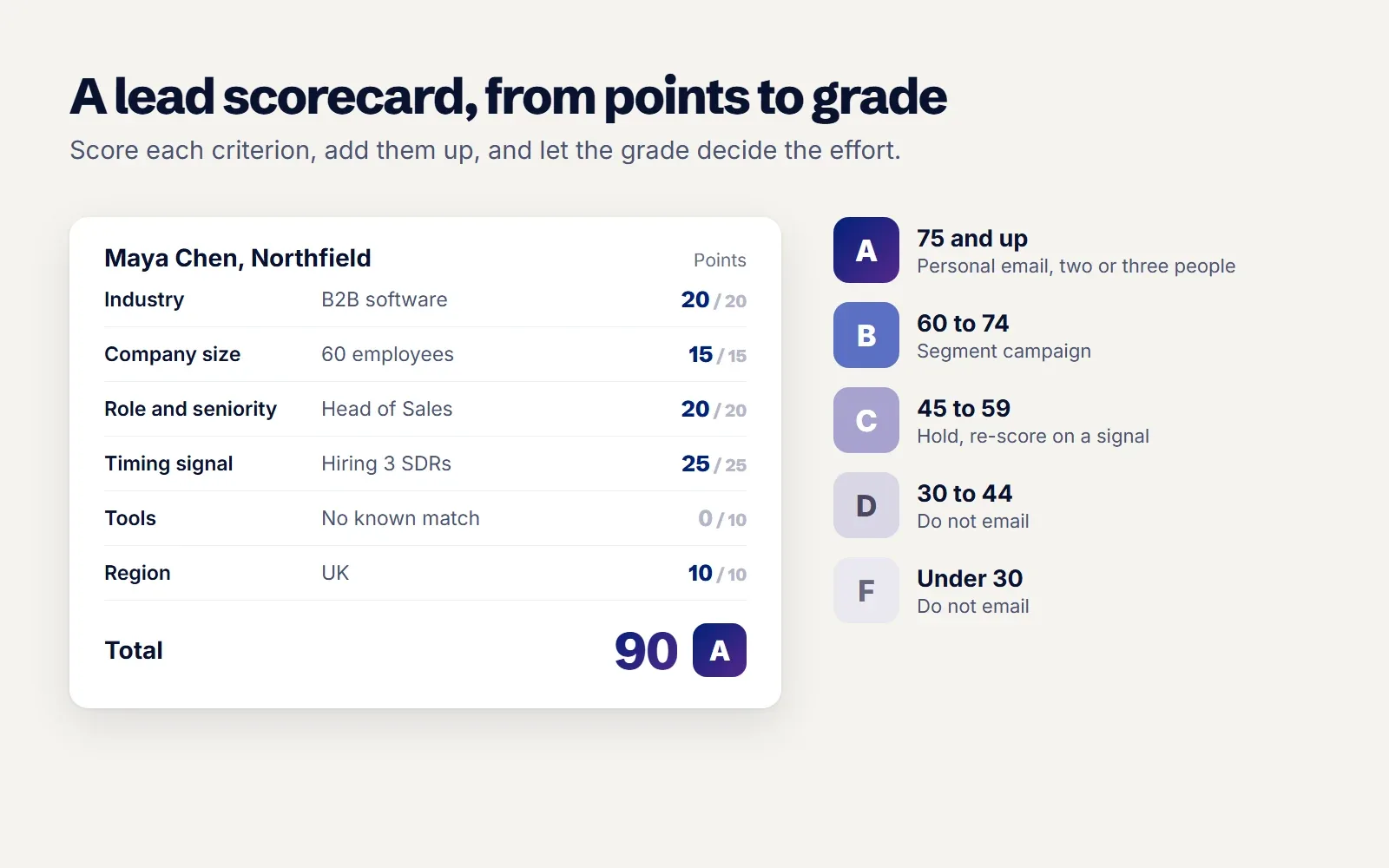
A profile that lives in a slide deck changes nothing. To be useful, it has to put a number on every lead so a rep can sort a list and start at the top. A simple points model works well, out of 100:
| Criterion | Example of a full match | Points |
|---|---|---|
| Industry | B2B software or agency, where we have case studies | 20 |
| Company size | 20 to 200 employees | 15 |
| Role and seniority | Head of sales, founder or sales operations | 20 |
| Timing signal | Hiring SDRs or raised funding in the last 90 days | 25 |
| Tools | Uses a tool we replace or integrate with | 10 |
| Region | UK, Ireland or US | 10 |
Give partial points for near misses, such as a company just outside the size band or a manager rather than a head of department. Weight the criteria by what your closed won data showed: if timing explained most of your fast deals, it deserves the most points.
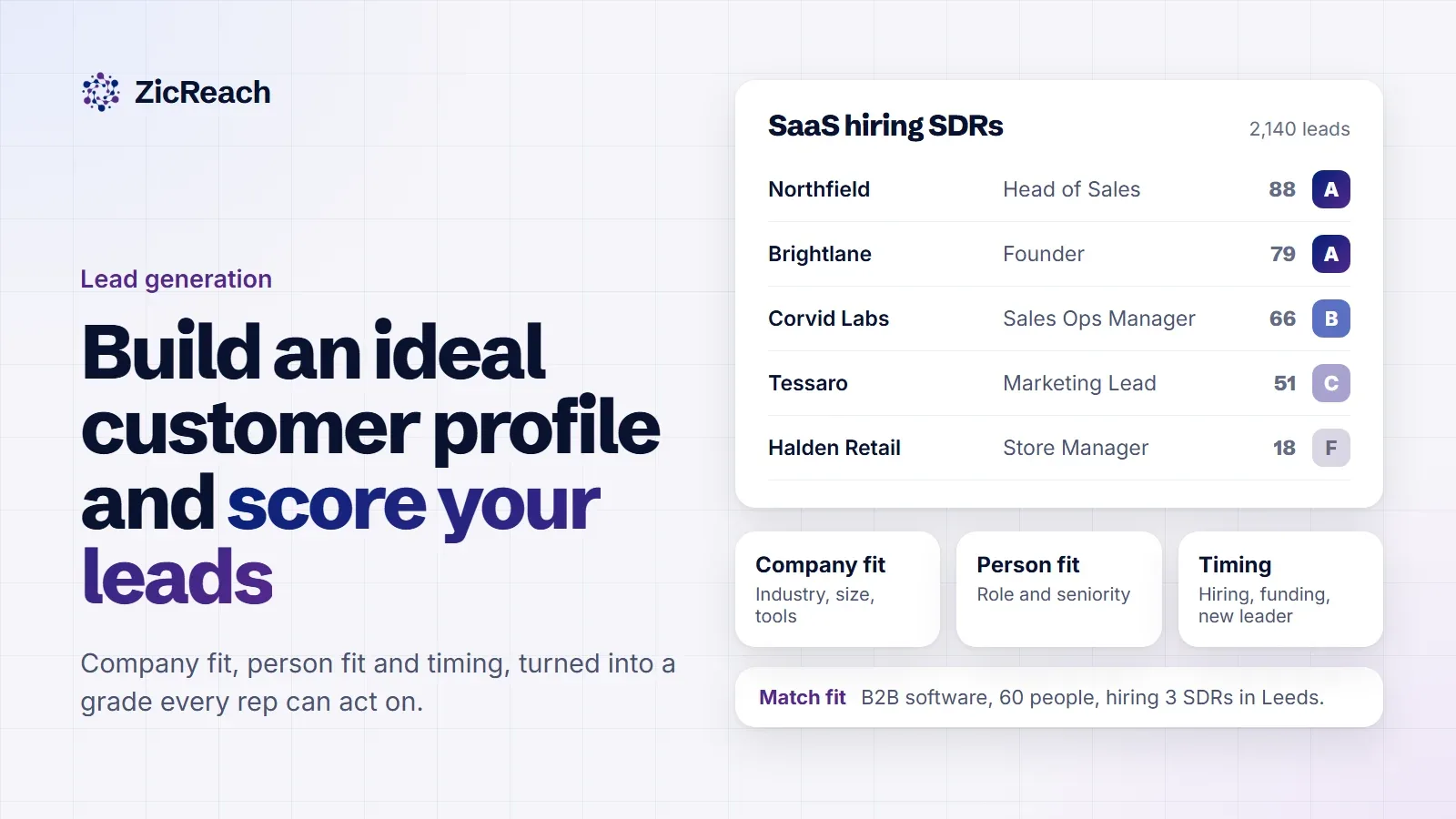
Then group scores into grades so they are easy to act on. ZicReach uses these bands, and they work well as a starting point for any model:
What to do with each grade
Grades are only useful if each one leads to a different action:
- A (75 and up): Research each one. Write a personal first line, reach two or three people at the account, and follow up by hand when they reply.
- B (60 to 74): Send a segment campaign with a strong shared reason to write, such as "companies hiring SDRs this month", with light personalization.
- C (45 to 59): Hold for later. Re-score when a timing signal appears, or use a lighter campaign when you have spare capacity.
- D and F (under 45): Do not email. They hurt your reply rate and, through ignored emails and spam complaints, your deliverability. Our guide on why cold emails go to spam explains how.
Sending only to A and B leads often feels like giving up volume. In practice it is the opposite of a loss: smaller, well matched campaigns reply better, keep spam complaints low, and protect the mailboxes you need for next month. Our guide on how to get more B2B sales meetings explains why a tighter list usually books more calls than a bigger one.
Check the score against reality every month
A lead score is a prediction, so test it. Once a month, look at reply rate, positive reply rate and meetings by grade. If A leads do not clearly beat B leads, your weights are off. Look at the meetings that came from C leads and ask what they had in common; that trait probably deserves more points. Update the ICP every quarter, or sooner after a big product change or a move into a new market.
Common mistakes
- Too broad. If your ICP describes 50,000 companies, it is a market, not a profile.
- Built from opinion. Profiles written in a workshop describe the customers you want, not the ones who buy.
- No timing layer. Fit without timing fills lists with companies that are right in theory and silent in practice.
- Scoring after sending. The score should decide who gets an email, not explain the results afterwards.
- Never revisited. Markets move. A profile from two years ago is describing a different company.
How ZicReach does this
In ZicReach you describe your business once, and ZicAgent scores every lead in your tables from 0 to 100 against it, grades it A to F (A is 75 and up, F is under 30) and writes a one line reason in a Match fit column, so you can see why each lead got its grade. Insights groups a table by grade with top titles and industries for each, and a grade window lets you copy, export or bin a whole grade at once, or add the rows you pick to a campaign.
For timing, the AI Leads Engine includes Find Jobs, which pulls open roles so you can reach a team the week it starts hiring, and Find Companies, which filters by growth, hiring and buying signals. AI columns let you ask any extra question of every row, such as "Do they sell to businesses?" or "Do they mention outbound on their careers page?". When the list is ready, you can ask ZicAgent to build the campaign for your A leads; nothing sends until you press Confirm. Before sending, make sure every address is current with our guide to finding verified business email addresses.
Questions people ask
What is the difference between an ICP and a buyer persona?
An ICP describes the companies most likely to buy and succeed with your product. A buyer persona describes the people inside those companies who feel the problem and make the decision. Outbound needs both, plus timing signals.
How many criteria should a lead score have?
Five or six is enough for most teams: industry, size, role, timing, tools and region. More criteria make the model harder to explain and rarely make it more accurate.
What lead score should I start outreach at?
Start with A leads, scoring 75 or more, and add B leads once you have capacity. Check reply and meeting rates by grade each month and move the threshold if the numbers say so.
How often should I update my ideal customer profile?
Review it every quarter, and after any big change in product, pricing or market. Re-score your lists whenever the profile changes.
Can AI score leads accurately?
AI is good at reading a company's website and profile against a clear description of your business, and at doing it for thousands of rows. It is only as good as the description you give it, so write down your ICP first and check the grades against real replies.
The short version
Build your ICP from customers you have already won, in three layers: company fit, person fit and timing. Write down what disqualifies a lead, turn the rest into a simple points score, and give each grade a different level of effort. Then check the grades against real replies every month.
To see how your own leads grade, start ZicReach for free, describe your business and run one search. The pricing page shows what each plan includes, and the founders page shows how a one person team runs outbound this way.
Put this into practice with ZicReach
Find leads, write the sequence and send from warmed inboxes in one place. Free to start, no card needed.
Start for free