How to improve your cold email reply rate: benchmarks and fixes that work
The average cold email campaign gets about a 3.4% reply rate; the best pass 10%. What the benchmarks say, how to read your own numbers, and nine fixes in the order we would try them.
 By
10 min read
By
10 min read
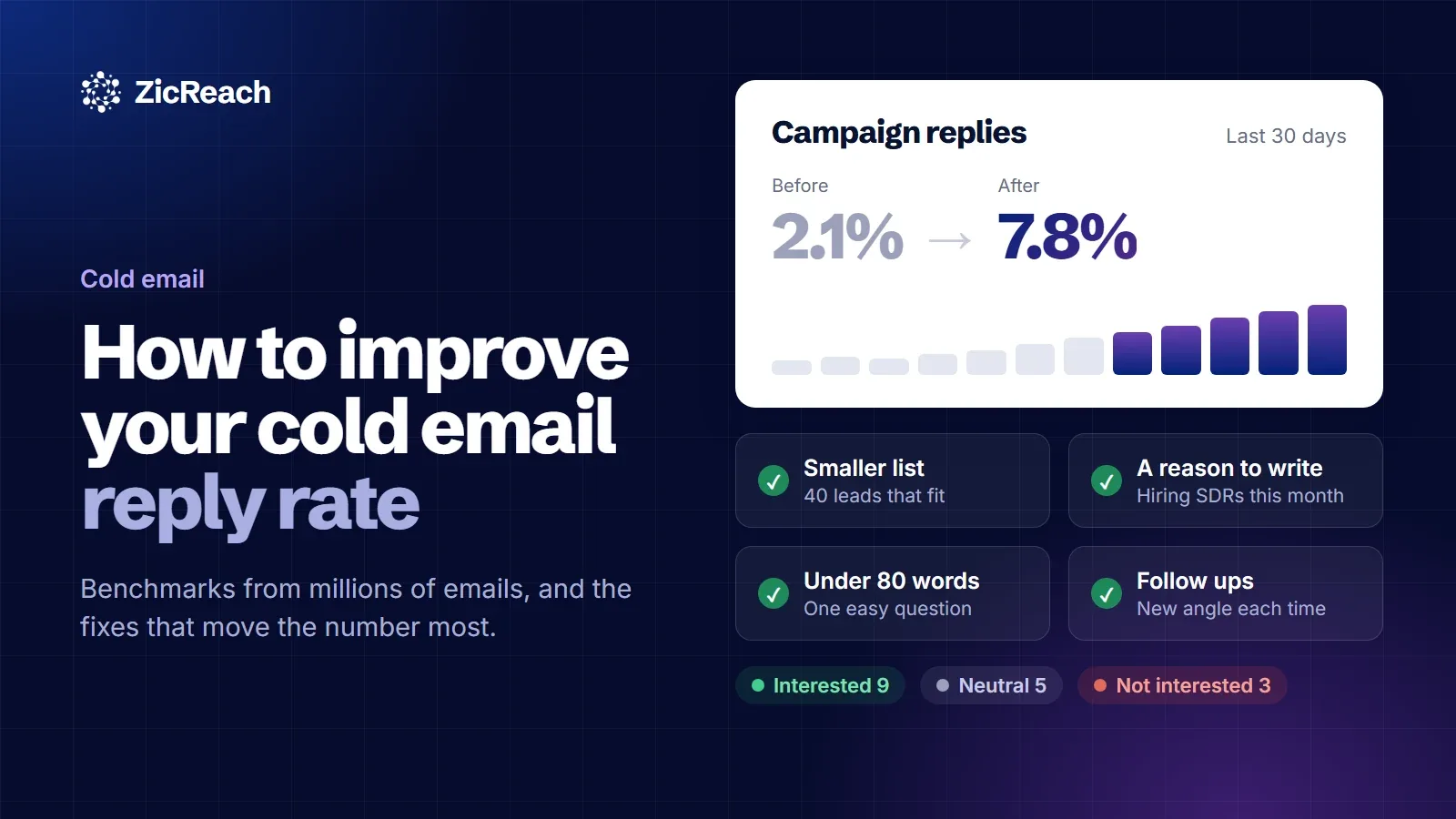
You sent 600 cold emails last month. Fourteen people wrote back. Three were out of office notices, two asked to be removed, and one said "not now, try in Q2". The campaign report says a 2.3% reply rate, and nobody on the team can tell you whether that is bad, normal, or a sign that something is broken.
This guide answers that question first, with current benchmarks from studies that cover millions of cold emails. Then it walks through the fixes that move reply rates the most, in the order we would try them, and ends with a table you can use to diagnose a campaign that has stalled.
What a good cold email reply rate looks like
Reply rates have fallen over the last few years as inboxes filled up and filters got stricter, so older numbers you find online are often too optimistic. Here is what the larger recent datasets say:
- Instantly's Cold Email Benchmark Report 2026, based on campaigns sent across its platform during 2025, puts the average reply rate at 3.43%. The top quarter of campaigns reach 5.5% or more, and the top 10% pass 10.7%.
- Backlinko's analysis of 12 million outreach emails found that 8.5% of emails got a response. That study is older and includes link building outreach, which tends to reply more than sales email, so treat it as a ceiling rather than a target.
- Woodpecker's cold email statistics, drawn from more than 20 million emails, show campaigns with fewer than 50 recipients averaging a 5.8% reply rate, against 2.1% for campaigns sent to 1,000 or more people.
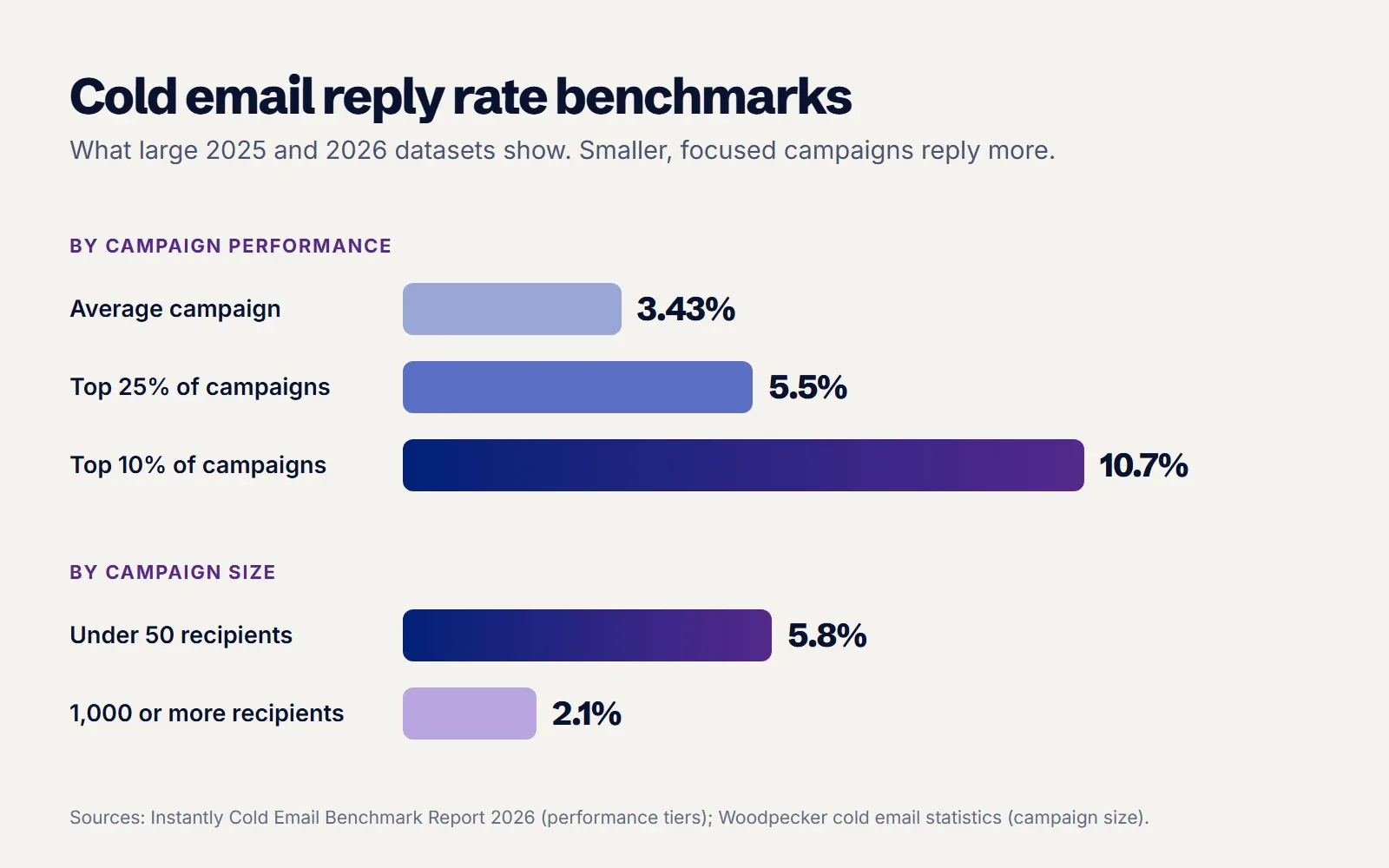
So a rough scale for B2B cold email in 2026: under 2% means something is wrong, 3 to 5% is ordinary, 5 to 10% is good, and over 10% usually means a tight list and a strong reason to write. Your market will shift these numbers. A campaign to founders of 20 person agencies will behave differently from one to procurement teams at banks, so the most useful benchmark is your own best campaign.
Count the replies that matter
A raw reply rate mixes auto replies, removals and real interest. Track two numbers instead: the total reply rate, which tells you whether people are reading, and the positive reply rate, which tells you whether the offer lands. A campaign with a 6% reply rate and a 0.5% positive rate has a targeting or offer problem. One with a 2% reply rate and a 1.5% positive rate is working and probably needs more of the right people, not new copy.
Before you rewrite anything, check the inbox
A low reply rate is often a delivery problem in disguise. If half your emails land in spam, no subject line will save them. Run a quick check before touching the copy:
- Send a test to a Gmail and an Outlook address and see which folder it lands in.
- Confirm SPF, DKIM and DMARC all pass in the message headers.
- Look at bounces. Above 2% means the list needs verifying before anything else.
- Check that each mailbox has been warmed up and is not sending more than a few dozen cold emails a day.
If any of those fail, start with our guide on why cold emails go to spam, and if your mailboxes are new, give them about three weeks of warmup before the first cold email. Fix delivery first. Everything below assumes the email is being seen.
1. Send to fewer people who clearly fit
The Woodpecker data above is the single most useful finding for most teams: small, focused campaigns reply at well over twice the rate of large ones. That is not because small numbers are magic. It is because a list of 40 people usually has something real in common, which lets you write an email that fits all of them.
Split big lists into segments that share a problem: same role, similar company size, same trigger. "Heads of sales at B2B software companies that started hiring SDRs this month" is a segment. "Sales leaders in tech" is not. If you are not sure who belongs in a segment, start from the customers you already won and look for what they had in common when they bought.
2. Give a reason to write to this person now
Every cold email is an interruption. The ones that get answered explain, in the first line, why this person is hearing from you this week. Good reasons are specific and checkable:
- They posted three SDR roles in the last fortnight.
- They opened an office in a new country.
- A new head of revenue joined in the last 90 days.
- Their pricing page changed, or they launched a product line.
Backlinko found that emails with personalized message bodies got a 32.7% better response rate than those without. The word "personalized" is doing a lot of work there. Inserting a first name and company name is table stakes. A sentence that could only have been written to this company is what makes the difference.
3. Keep the first email short, with one ask
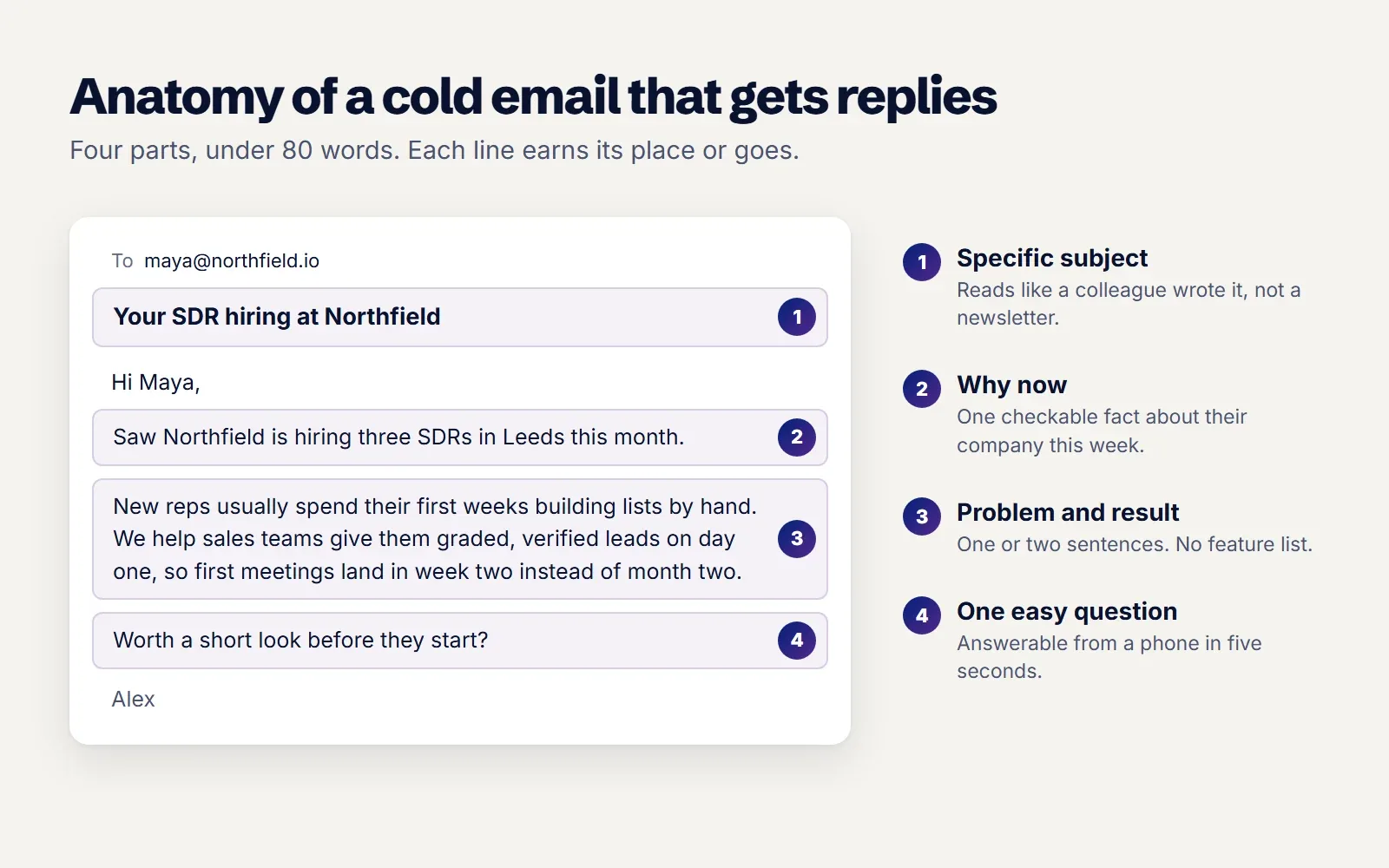
Instantly reports that the best performing campaigns average fewer than 80 words in the first email and use a single, clear call to action. That matches what we see. A cold email has about three jobs: say why you are writing, say what you can do about a problem they probably have, and ask one easy question.
Cut anything that does not serve those jobs. Company history, a list of features, three links and a calendar link in the first email all make the reader work harder. A good ask is easy to answer from a phone: "Worth a look?" or "Is this on your list for this quarter?" works better than "Can you do 30 minutes on Tuesday at 2pm?"
4. Write subject lines that look like a colleague wrote them
The subject line decides whether the email gets opened, and it also tells the reader what kind of email this is. In the Backlinko study, personalized subject lines lifted responses by 30.5%, and subject lines of 36 to 50 characters did better than very short ones.
The style that works for cold email is plain and specific: "Your SDR hiring at Northfield", "Question about the Leeds office", "Idea for your onboarding emails". Avoid anything that looks like marketing, such as capital letters, emojis, numbers in brackets and fake "Re:" prefixes. A fake reply might lift opens once, and then it teaches people not to trust you.
5. Follow up, more than once
Most replies do not come from the first email. Backlinko found that a single follow up lifted replies by 65.8%. Instantly's data shows the first email brings in 58% of replies and the follow ups bring in the other 42%, and recommends four to seven touches spaced three to four days apart.
Follow ups work when each one adds something: a short case, a different angle on the problem, a useful resource, or a simple "should I stop writing?" at the end. They fail when they say "just bumping this up" three times. Send them as replies in the same thread, keep each shorter than the last, and stop the moment someone answers or opts out.
6. Reach more than one person per account
B2B purchases are rarely one person's call. Backlinko found that outreach sent to multiple contacts at the same organization lifted response rates by 93%, and that sequences to several contacts performed 160% better than a single email to one person.
Pick two or three people with a stake in the problem, for example the head of sales, a sales operations manager and the founder at a smaller company. Write to each about their part of the problem, not the same email three times, and stagger the start dates by a few days. Stop the sequence for everyone at that company as soon as one person replies.
7. Send when people read email
Timing is a smaller lever than targeting, but it is free. Backlinko found weekday emails got 23.3% more replies than weekend ones. Instantly's 2026 data shows Wednesday with the highest engagement and a surge of auto replies on Fridays.
The practical rule: send on weekdays, during the recipient's working morning in their own time zone. A campaign that sends at 9am London time reaches New York at 4am, where it sits under everything that arrives before they wake up.
8. Test one thing at a time
Reply rates move around from week to week for reasons that have nothing to do with your copy. If you change the list, the subject, the first line and the offer at once, you will never know what worked. Change one thing, send each version to at least a few hundred people from the same segment, and compare positive replies, not opens.
The order that usually pays off: the list first, then the reason for writing, then the offer, and only then the subject line and wording.
9. Answer replies fast
This does not raise the reply rate, but it decides how many replies become meetings. Research in Harvard Business Review on the short life of online sales leads found that firms which contacted a lead within an hour were far more likely to qualify it than those that waited even a little longer. A "yes, send me more" that sits for two days goes cold. Our guide on how to get more B2B sales meetings covers this leak in more detail.
Diagnose a stalled campaign
When a campaign underperforms, the pattern in the numbers usually points to the cause:
| What you see | Likely cause | First fix |
|---|---|---|
| Almost no replies of any kind, low opens | Emails landing in spam or Promotions | Check authentication, warmup and placement before the copy |
| Bounces above 2% | Stale or guessed addresses | Verify the list right before sending; pause and clean |
| Normal opens, few replies | Generic copy or a weak reason to write | Narrow the segment and rewrite the first line |
| Plenty of replies, mostly "not interested" | Wrong people or wrong offer | Revisit who is on the list and what you ask for |
| Replies only to the first email | Follow ups repeat the first email | Give each follow up a new angle or proof point |
| Positive replies, few meetings | Slow or clumsy responses | Answer the same morning with a simple next step |
How ZicReach helps
We built ZicReach to make the fixes above the default rather than extra work.
- Smaller, better lists. The AI Leads Engine finds people, companies and open jobs, and grades every lead from A to F against your business, so it is easy to send to the 40 people who fit instead of the 4,000 who might.
- Short sequences with real follow ups. AI Email Marketing drafts the first email and each follow up from what you tell it about your business, sends follow ups in the same thread, stops for anyone who replies, and runs A/B subject lines so you can test one thing at a time.
- The right time zone. Campaigns send in each lead's local working hours, on the days you choose.
- Inbox first. AI Warmup is free for every mailbox, and a health score pauses campaigns on a mailbox that starts to slip.
- Fast answers. Unibox collects replies from every mailbox and tags them Interested, Neutral or Not interested, so the good ones are answered first.
Questions people ask
What is a good reply rate for cold email?
Recent large datasets put the average around 3 to 3.5%, with the top quarter of campaigns at 5.5% or more and the best 10% above 10%. Aim to beat your own best campaign, and track positive replies separately from auto replies and removals.
Does personalization really improve replies?
Yes, when it is relevant. Backlinko found personalized bodies replied about a third more often. A first name alone does not count; a line that explains why you chose this company is what moves the number.
How many follow ups should I send?
Plan on three to five follow ups spaced a few days apart. Instantly's data shows follow ups bring in about 42% of all replies, so stopping after one email throws away a large part of your results.
What is the best day to send cold emails?
Weekdays beat weekends, and midweek tends to do best, with Wednesday leading in Instantly's 2026 data. Sending in the recipient's own working morning matters more than the exact day.
Should out of office replies count toward my reply rate?
Report them, but do not celebrate them. Keep a total reply rate to show whether people are reading, and a positive reply rate to judge the campaign. The second number is the one that books meetings.
The short version
Most low reply rates come from the same few causes: emails that never reach the inbox, lists that are too broad, first lines that could go to anyone, and sequences that stop after one try. Fix delivery, then narrow the list, give a real reason to write, keep it short, follow up with something new, and answer fast.
If you want to try this on your own market, start ZicReach for free, build a small graded list and send one focused campaign. The pricing page shows what each plan includes.
Put this into practice with ZicReach
Find leads, write the sequence and send from warmed inboxes in one place. Free to start, no card needed.
Start for free